


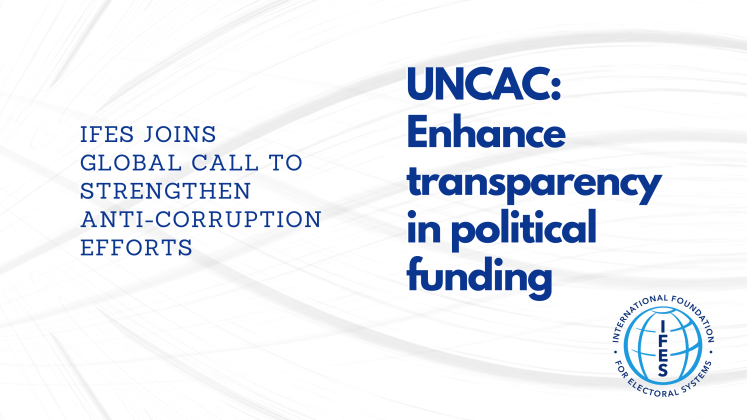
IFES Joins Global Call to Strengthen Anti-Corruption Efforts
The International Foundation for Electoral Systems (IFES) is pleased to join over 200 organizations and experts worldwide in endorsing an open letter to delegates at the Conference of the States Parties to the United Nations Convention against Corruption calling for a commitment to integrity in the funding of political parties and candidates.
The letter calls on the UNCAC States Parties to adopt a strong resolution to enhance transparency in political funding to prevent corruption in politics and promote accountability to citizens. The 11th Conference of the States Parties takes place in December 15-19, 2025, in Doha.
This appeal reflects IFES’s long-standing dedication to integrity, civic participation, and public trust in governance. When institutions are transparent and civic space is protected, citizens have greater confidence in their governments and democracy is able to deliver on its promises. As noted in the letter, “Countries with transparent political funding, a commitment enshrined in Article 7, paragraph 3 of the Convention, perform better at controlling corruption and delivering on the common good.”
By supporting this commitment to integrity, IFES highlights its continued focus on transparency, civic participation, and accountability as the foundation of strong and sustainable democracies.
The International Foundation for Electoral Systems (IFES) is an official observer to the UNCAC Implementation Review Mechanism (IRM) and active member of the UNCAC Coalition.
IFES works with a broad network of international and regional partners to strengthen integrity and accountability systems around the world. These partners include the United Nations Office on Drugs and Crime (UNODC), Transparency International, the OECD, the Council of Europe, the African Union, and the ASEAN Parties Against Corruption (ASEAN-PAC). IFES also collaborates with the Open Government Partnership (OGP) to support cooperation between governments and civil society on transparency and open governance.
Through these partnerships, IFES supports programs that put anti-corruption standards into practice. Its work includes improving political finance transparency, strengthening regional cooperation, supporting oversight and digital reporting, and advancing accountability through civic and government partnerships.
As an official observer to UNCAC and a member of the UNCAC Coalition, IFES contributes technical expertise and field experience to global anti-corruption efforts. These programs reflect IFES’s broader commitment to advancing the goals of the UNCAC and promoting stronger, more accountable democratic institutions.
The 11th Conference of the States Parties (CoSP) to the United Nations Convention against Corruption (UNCAC) in December 2025 is an important moment for governments and civil society to come together to strengthen global anti-corruption efforts.
Open Letter to Delegates at COSP11
Distinguished Delegates to the 11th Conference of the States Parties to United Nations Convention against Corruption (Doha, 15 to 19 December 2025):
Commit to integrity in the funding of political parties and candidates
We, the undersigned domestic and regional networks of election monitoring organisations, democracy and anticorruption civil society and international organisations from across the globe, express our commitment to the precepts of the United Nations Convention against Corruption, reflecting a nearly universal consensus on fostering integrity in public life.
As you meet to take stock of the Convention’s implementation in Doha next week, we encourage you to build upon the steps taken domestically and adopt a strong resolution to enhance transparency in political funding to prevent corruption in politics and promote accountability to citizens.
Money is essential to healthy politics when flows are transparent to voters and have no conditions attached. Political funding that is opaque and unchecked can enable different forms of corruption, from concealing the political influence of criminal or illicit interests and rigging procurement processes to reward loyal donors, to entrenching kleptocratic regimes that rely on state funds to maintain their hold on power. Unchecked political funding can drive up the costs of participating in politics – let alone standing a chance of winning office – turning it into an exclusive club. Lack of effective controls on money also leaves election outcomes vulnerable to external interference, significantly increasing the risk of corruption in politics.
Countries with transparent political funding, a commitment enshrined in Article 7, paragraph 3 of the Convention, perform better at controlling corruption and delivering on the common good. Implementation is lagging though. Reports on the Convention’s Implementation Review Mechanism, independent surveys on the publication of campaign donation information online and assessments of the integrity of campaign finance safeguards in the electoral cycle, show more can, and needs to be done to increase transparency. However, there is a lack of international commitments that governments can be held accountable to.
We ask you to be ambitious and support the draft Resolution tabled by Albania, Ghana, Mongolia and Norway to close gaps in the implementation of the Convention, as follows:
- Publish political finance reports online
Transparency is the cornerstone of democracy and integrity. CoSP11 should encourage political parties and candidates to report on their income and expenditure, and proactively publish this information online, free of charge, as nearly in real time as possible, and in open, machine-readable formats the public can understand and use. Publication must identify donors in the pre-election period, to reduce risks of donations that can result in conflicts of interest such as donations from government contractors.
- Close loopholes to illicit financial flows in politics
CoSP11 should promote the use of banking systems to manage funds, the disclosure of beneficial ownership of corporate donors and ban shell companies and straw donors from making donations. It should also ensure the transparency of third-party expenditures in election campaigns and other relevant anti-money laundering protections to stop illicit funds, domestic or foreign, from being used to curry favour or exert undue influence.
- Invest in oversight
States Parties must promote accountability for political finance by equipping oversight bodies with strong mandates and adequate funding to provide guidance to political parties and candidates on their integrity obligations; monitor and enforce compliance with political finance regulations; establish safe and confidential channels for reporting irregularities, and collaborate with other agencies to investigate and sanction violations.
- Engage society
An informed and engaged public is a bulwark of integrity in political finance. Indeed, civic groups and journalists are often critical partners for governments in innovating to track and address new tactics of undue financial influence, such as the increasing use of cryptocurrency to move funds to straw donors and disingenuous third-party influence online. The resolution must encourage access to political finance data for civic groups and protections from harassment or reprisals when those groups report on abuses. Likewise, it must encourage collaboration among private sector, the media, and election observation groups with election commissions, anticorruption watchdogs, and law enforcement. We pledge to collaborate with governments and with each other in keeping political and campaign financing free from undue influence.
- Reduce the costs of doing politics
The excessive costs of campaigning create structural barriers to entry, especially for women and young politicians. When contesting elections gets expensive, there is an incentive for resorting to illicit sources of funding. States parties should adopt measures such as clearly defined campaign periods and expenses, equitable allocation of public political financing, and affordable nomination fees, including fees charged for political party primaries, to ensure that running for office is not prohibitively expensive and remains open to diverse candidates.
- Prevent abuse of state resources in elections
The misuse of public resources for partisan advantage is a widespread corruption offence covered by Articles 17 and 19 of the Convention. It greatly undermines electoral integrity. Governments must enforce strong safeguards and sanctions against the manipulation of public monies, officials, infrastructure, and laws to influence electoral outcomes.
- Commit to the effective implementation of the Resolution
A strong resolution is a starting point. We call on States Parties to actively advance the implementation of the resolution at the international and national levels, while involving the public, civic groups and other relevant stakeholders in the electoral process. We commit to supporting this follow-up and monitoring progress in our own work.
Improving transparency and strengthening governance in political finance is essential to reducing the incentives and opportunities for corruption in politics.
The fight against corruption and the preservation of democratic values are interlinked. It is imperative that we adapt to the evolving challenges of corruption in the twenty-first century. Adopting a strong resolution on political finance can be a significant step towards a more transparent, accountable, and equitable political landscape. The UNCAC embodies a global commitment to these ideals. We call on all States Parties to work collaboratively to address these issues, both domestically and internationally, in a spirit of shared responsibility.
Thank you for your attention and commitment to this vital cause.
Codrafters
African Election Observers Network (AfEONet)
Alliance for Finance Monitoring (ACFIM)
Asian Network for Free Elections (ANFREL)
European Platform for Democratic Elections (EPDE)
Global Civil Society Coalition for the UNCAC (formerly: UNCAC Coalition)
Inter-American Network for Election Observation (RedOIE)
International Foundation for Electoral Systems (IFES)
International Institute for Democracy and Electoral Assistance (International IDEA)
The Carter Center
Transparency International
Westminster Foundation for Democracy
Institutional Signatories to the Letter
- Acción Ciudadana (Transparency International Guatemala)
- Accountability Lab
- Action Jeunesse pour le Développement
- Africa Centre for Open Governance (AfriCOG)
- Africa Freedom of Information Centre
- African Center for Governance, Asset Recovery and Sustainable Development
- African Centre for Media & Information Literacy
- AfricTivistes
- Ágora
- Albanian Center for Economic Research (ACER)
- Alliance for Accountability Advocates Zambia (AAAZ)
- Alliance for Finance Monitoring (ACFIM)
- Amalna South Sudan
- Anti-Corruption Academy Foundation
- Anti-Corruption Data Collective
- Anti-Fraud Initiative Ghana (AFIG)
- Asian Cultural Forum on Development (ACFOD)
- Asociación Acción Ciudadana (El Salvador)
- Asociación Civil Transparencia (Perú)
- Asociación Costa Rica Integra (Transparency International Costa Rica)
- Association Burundaise des Consommateur (Transparency International Burundi)
- Association for Democracy in the Maldives (ADM)
- Association for Democratic Reforms (ADR, India)
- Association Guinéenne pour la Transparence
- Association Nigérienne de Lutte Contre la Corruption (Transparency International Niger)
- AWTAD Organization for Combating Corruption
- Bahrain Transparency (Transparency International Bahrain)
- Bangladesh NGOs Network for Radio and Communication
- Besa Global
- Center for Fiscal Transparency and Public Integrity
- Center Science and Innovation for Development - SCiDEV
- Centre for Human Rights and Climate Change Research
- Centre for Peace and Development Initiatives (CPDI)
- Centre Stratégique Pour La Promotion Du Développement Durable (CSPDD)
- Centro de Gobernanza Publica y Corporativa
- CHESNO Movement
- Children and Young People Living for Peace (CYPLP)
- CiFAR - Civil Forum for Asset Recovery e.V.
- CISE Malawi
- Civil Society Legislative Advocacy Centre - CISLAC (Transparency International Nigeria)
- CLUB Ohada Thiès
- COMMUNITY ACTION FOR HEALTH AND DEVELOPMENT
- Corruption Watch (Transparency International South Africa)
- CREFDI
- Democracy Reporting International
- Democratic Insights Group
- Eagle Eye Transparency And Integrity Initiative
- Earth League International (ELI)
- Electoral Support Network of Southern Africa
- Friends of Angola
- Fundación Ciudadanía y Desarrollo (Transparency International Ecuador)
- Fundacion Multitudes (Chile)
- Fundación Nacional para el Desarrollo (Transparency International El Salvador)
- Fundeps (Argentina)
- Good Governance Team Nigeria (GGTNIGERIA)
- Godiya Women Education and Sustainable Development Initiative
- Gong (Croatia)
- Good Governance Africa
- GTA Foundation
- Indonesia Corruption Watch
- Institute for Democracy and Economic Affairs (IDEAS)
- Institute for Democracy and Mediation
- Institute for Democratic Reforms & Electoral Studies (IRES)
- Institute for Security Studies
- Instituto Panamericano de Derecho y Tecnología (IPANDETEC)
- Jordan Transparency Center
- Kosova Democratic Institute (Transparency International Kosovo)
- Libera - Associazioni, nomi e numeri contro le mafie
- Liberia CSOs Anti-Corruption Coalition
- Ligue Congolaise de lutte contre la Corruption - LICOCO (Transparency International Democratic Republic of the Congo)
- Maison des Organisations de la Société Civile (MOSC) Anjouan
- Metamorphosis Foundation for Internet and Society
- Mexiro A.C
- Migrant Workers Association of Lesotho
- Mongolian Civil Society Coalition for Fair Elections (Open Society Forum, Voter Education Center, Youth Policy Watch, Factcheck.mn, MIDAS, Globe International, National Center for Comprehensive Development)
- Movimento de Combate à Corrupção Eleitoral (MCCE)
- National Campaign for Sustainable Development (Nepal)
- Netherlands Helsinki Committee
- Nyika Institute
- Observatoire Citoyen des Droits et de lutte contre la Corruption en RDC
- Open Ownership
- OpenSecrets
- Pakistan Rural Workers Social Welfare Organization, PRWSWO
- Paradigm Leadership Support Initiative
- Participación Ciudadana (Transparency International Dominican Republic)
- Partnerships for Integrity (P4I)
- Poder Ciudadano (Transparency International Argentina)
- Political Parties of Finland for Democracy - Demo Finland
- Proética (Transparency International Peru)
- Public-Private Integrity (PPI)
- Qendra "Durrësi Aktiv"
- Repatriation Group international
- Rural Development Organization (Pakistan)
- SAMUHIK ABHIYAN, Kathmandu
- Somali Journalists Syndicate (SJS)
- Spotlight on Corruption
- The Daphne Caruana Galizia Foundation
- The Meluibe Empowerment Foundation
- The Network for Affirmation of NGO Sector - MANS
- The Vision for Teenagers Adolescents and Youths Wellbeing Initiative
- Transparencia Mexicana (Transparency International Mexico)
- Transparencia por Colombia (Transparency International Colombia)
- Transparency Initiative Seychelles (Transparency International Seychelles)
- Transparency International Anticorruption Center (Transparency International Armenia)
- Transparency International Australia
- Transparency International Austria
- Transparency International Bangladesh
- Transparency International Bosnia and Herzegovina
- Transparency International Brazil
- Transparency International Bulgaria
- Transparency International Cambodia
- Transparency International Canada
- Transparency International Denmark
- Transparency International Deutschland e.V.
- Transparency International España
- Transparency International EU
- Transparency International France
- Transparency International Ghana
- Transparency International Indonesia
- Transparency International Initiative Madagascar
- Transparency International Italia
- Transparency International Kenya
- Transparency International Lithuania
- Transparency International Macedonia
- Transparency International Malaysia
- Transparency International Moldova
- Transparency International Nepal
- Transparency International Netherlands
- Transparency International New Zealand
- Transparency International Norway
- Transparency International Papua New Guinea
- Transparency International Romania
- Transparency International Slovakia
- Transparency International Slovenia
- Transparency International Sri Lanka
- Transparency International Switzerland
- Transparency International Taiwan
- Transparency International Türkiye
- Transparency International U.S.
- Transparency International UK
- Transparency International Zambia
- Transparency Maldives (Transparency International Maldives)
- Transparency Maroc (Transparency International Morocco)
- Transparency Serbia (Transparency International Serbia)
- Trinidad and Tobago Transparency Institute (Transparency International Trinidad and Tobago)
- Voto Joven
- Vouliwatch
- Whistleblowers of America