


IFES Presents 2025 Democracy Award to Leaders in Technology and Democracy
IFES presented its 2025 Charles T. Manatt Democracy Award to two outstanding leaders at the intersection of technology and democracy.
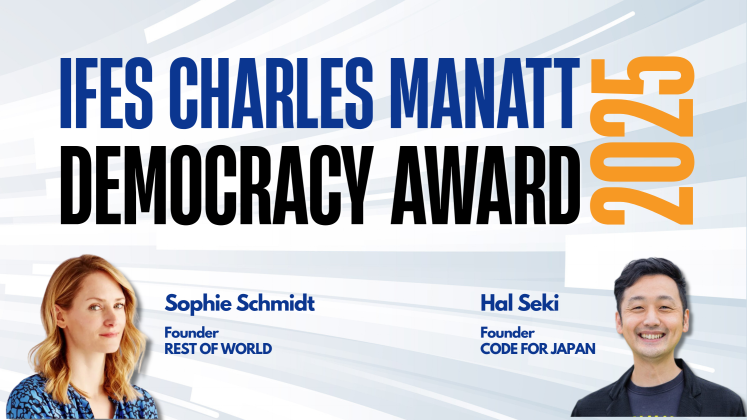
October 6, 2025: The International Foundation for Electoral Systems (IFES) presented its 2025 Charles T. Manatt Democracy Award to two outstanding leaders at the intersection of technology and democracy: Sophie Schmidt, Founder and Publisher of Rest of World, and Hal Seki, Founder of Code for Japan.
Since its inception, the Manatt Democracy Award has honored individuals who have demonstrated an enduring commitment to democracy. This year, IFES aligned the award with the theme of its fourth strategic objective: “Technology, data, AI, and the internet positively serve elections and democracies.”
“The IFES mission is simple but profound: Together, we build resilient democracies that deliver for all,” said Anthony Banbury, President and CEO of IFES. “This year’s honorees exemplify that mission through their commitment to transparency, innovation, and global inclusion.”
IFES is grateful for the role of its A.I. Advisory Group on Elections (AI AGE) this year in nominating Manatt honorees.
Sophie Schmidt: Championing Global Tech Journalism Beyond the West
Just as big multinational corporations too often deprioritize non-western markets, so too do media conglomerates ignore the markets that are categorized as “rest of world.” Sophie Schmidt sought to address both gaps by launching Rest of World, a dynamic, innovative online publication that has become “an indispensable source of information that captures people’s experiences with technology outside the West.”
In 2024, the “mega-year of elections,” Schmidt and Rest of World launched an innovative AI Elections Tracker that analyzed the impact of AI-driven misinformation on global elections. And as artificial intelligence began to impact electoral contexts for the first time, the on-the-ground journalists of Rest of World were doing careful on-the-ground reporting. These efforts documented AI’s use in such a way as to be available for future reference and study – truly vital and essential work that will only be fully recognized years from now when we reflect on the origins of how AI remade the world we live in.
“Sophie Schmidt has built a platform that broadens the world’s understanding of how technology affects democracy,” said IFES President and CEO Tony Banbury. “Her leadership and vision embody the spirit of innovation and inclusivity that this award celebrates.”
Schmidt, who joined the ceremony virtually from California, in her remarks acknowledged that, “Yes, we're in an age where digital technology enhances the power of autocrats and bad actors.” But, she went on, “the flip side is access:
“More people have access to these [tech] tools every day. A hundred million people join the internet every year. And they're not waiting for permission. They’re building. Experimenting. People learn fast. They will find ways to use tech to help their families and strengthen communities.
“When we began publishing, people asked if Rest of World was pro-tech or anti-tech. I said we're pro-humanity. Even now—with artificial superintelligence, autonomous surveillance drones, all of it—I would bet on humans every day.”
Hal Seki: Pioneering Civic Technology in Japan
Hal Seki’s pioneering work to connect Japanese government with engineers and coders to address crises and solve governance challenges has been instrumental in making government more responsive to its citizens. As Founder of Code for Japan, Seki has built one of the country’s largest civic tech communities—connecting coders, engineers, and local governments to co-create technology solutions that improve governance and strengthen trust between citizens and institutions. With Code for Japan, “Our vision is simple, yet profound: think together, create together,” Seki explained.
“We believe democracy is not only about choosing leaders at the ballot box. It is about co-creating the commons, the systems and relationships that sustain public life. It is about shaping policies together, not just delegating them.”
Banbury noted that IFES’ mission statement is together, we build resilient democracies that deliver for all.
“I don’t always focus on the “deliver” part of our mission statement, but democracies must deliver – whether good governance or rule of law – to maintain their legitimacy. So for his work in deploying technology to ensure that democracy delivers for all, I am proud to present this award to Hal Seki, founder of Code for Japan.”
In accepting the award, Seki, who joined the ceremony virtually from a remote civic tech retreat in Nara Prefecture, Japan, shared that:
"Defending democracy today means defending our shared information space through openness and collaboration… None of this work happens in isolation. Democracy cannot be maintained by government alone, nor by civil society or the private sector acting separately. It requires ongoing dialogue and shared responsibility. At Code for Japan, we have learned that the most effective innovations come from multi-stakeholder collaboration when public officials, engineers, academics, and the citizens co-create solution on equal footing."
About IFES
The International Foundation for Electoral Systems (IFES) advances a world where people are free, societies are democratic, and elections are fair. As a leader in the democracy support community, IFES designs and implements flexible programs grounded in a clear understanding of these global forces as well as local political and economic dynamics; underpinned by equitable partnerships that amplify local voices; and guided by a holistic approach to safeguarding the communities in which we work. Since 1987, IFES has worked in more than 145 countries, from developing to mature democracies. IFES is a global, nonpartisan organization registered as a nonprofit organization [501(c)(3)] under the United States tax code.