



IFES President Delivers Annual Lecture on Asian Democracy
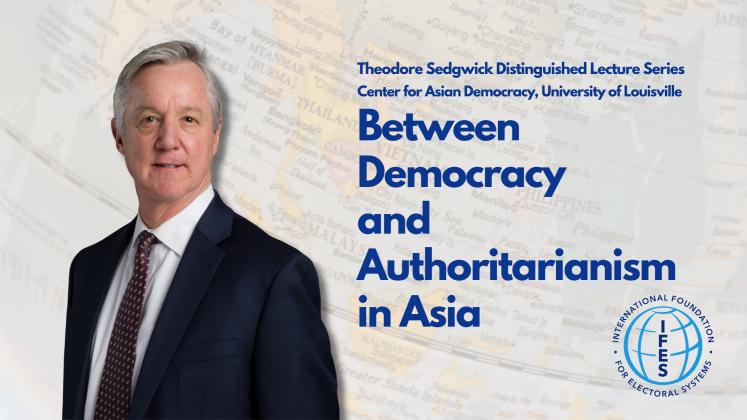
Banbury’s lecture was titled, “Between Democracy and Authoritarianism in Asia: Opportunities, Challenges, and the United States’ Changing Role”
On April 21, 2026, IFES President Tony Banbury delivered the Annual Lecture on Asian Democracy that is hosted yearly by the Center for Asian Democracy at the University of Louisville, Kentucky.
This year, the annual lecture was co-sponsored with the Center for Asian Democracy at the University of Louisville and presented by the University of Louisville’s Christina Lee Brown Envirome Institute in collaboration with The Filson Historical Society. It was also part of the Theodore Sedgwick Distinguished Lecture Series.
The Center for Asian Democracy was created through an endowment from the U.S. Department of State in 2006 with the purpose of promoting understanding, research and teaching about democracy and the prospects for democratization in Central, East, South, and Southeast Asia. Through publications, conferences, workshops, visiting scholar programs, colloquia, and research projects, the Center is an important forum for studying political dynamics in this vital region.
The Annual Lecture is a flagship public event in which the Center spotlights a prominent advocate for democracy and rights in the region. The Annual Lecture was established in 2012, and, since has welcomed a range of distinguished scholars, policymakers, and activists, including U.S. Ambassador Derek Mitchell, Chinese human rights activist Harry Wu, Malaysian political cartoonist Zunar, and investigative reporter Patricia Evangelista from the Philippines. In 2024-25, Dr. Badiul Majumdar from Bangladesh’s post-revolutionary “Consensus Commission” addressed ongoing challenges in that country’s political transition. IFES President and CEO Tony Banbury was honored to join this distinguished line-up.
Tony's lecture title was: "Between Democracy and Authoritarianism in Asia: Opportunities, Challenges, and the United States’ Changing Role."
You can watch the full lecture below. Continue scrolling for the full text.
2026 Center for Asian Democracy Annual Lecture Theodore Sedgwick Distinguished Lecture Series

Between Democracy and Authoritarianism in Asia: Opportunities, Challenges, and the United States’ Changing Role
Good evening.
It is an honor to deliver the 2026 Annual Lecture on Asian Democracy as part of the Theodore Sedgwick Distinguished Lecture Series.
I am President and CEO of the International Foundation for Electoral Systems – IFES. For more than three decades since we were established in 1987, IFES was an elections technical assistance organization. In 2019, with support from our Board and leaders like Tod Sedgwick, we transitioned from an elections organization to a democracy organization. The challenges I will be discussing today, the struggle between democracy and autocracy, are at the heart of why we made that big change.
IFES has worked in more than 145 countries in all regions of the world. The Asia-Pacific region is traditionally our largest by program size. Last year we lost over 70% of our funding due to reductions in U.S. foreign assistance. It was a difficult year, but we have stabilized thanks to support from other governments, foundations, and private individuals. Our work continues and, as I believe my remarks will show, that work is more important today than it has ever been.
Although I am now running a democracy organization, I was an Asia guy long before I was a democracy guy.
I became intrigued by Asia as an undergraduate in college, when I started studying the human rights situation of Cambodians who had fled the Khmer Rouge or the Vietnamese and were living in camps along the Thai-Cambodia border. After I graduated, I bought a one-way ticket to Bangkok in a quest to go work in those camps. Stepping off the plane in 1988 in Don Muang airport during the monsoon is a feeling I will never forget. After a lot of pestering, the United Nations, which was supporting those camps, hired me as a human rights officer.
The camps were formally controlled by the Coalition Government of Democratic Kampuchea, which was made up of the Khmer Rouge, the royalist FUNCINPEC party, and the remnants of the Lon Nol republicans, the Khmer People’s National Liberation Front. Working on human rights in those camps taught me some early, difficult, but important lessons about how rulers can be quick to abuse power in order to retain it, and the extent to which they will go to avoid being subjected to accountable – or democratic – governance.
After two years in the camps and a break for grad school, I went to Cambodia in 1992 as part of the UN’s first post-Cold War multi-dimensional peacekeeping mission, again as a human rights officer. There I saw the entire apparatus of the state put at the disposal of a political party, the Cambodian People’s Party or CPP, and saw it used to kill, torture, silence and otherwise intimidate political opponents. And when the killing and intimidation was not enough to silence the voices of the Cambodians who yearned to have the royal family return to rule, the world saw the results of the election administered by the UN ignored by the CPP’s ruler, Hun Sen, who would go on to rule Cambodia for the next 30 years, eventually handing the reins of power to his son in 2023.
These early experiences in Asia with unaccountable, authoritarian rule, and widespread, severe human rights abuses were formative for me. I left Asia in 1993 and returned a decade later as the Asia Regional Director for the UN World Food Programme. Over the course of the next six years, I had the tremendous privilege to travel extensively throughout the Asia-Pacific region, and not just to capitals but to remote corners of the countries where the poorest and most food-insecure people tended to live. I drove all over North Korea during the course of multiple visits, traveled to the Tibetan-inhabited areas of western China, visited all regions of Myanmar where ethnic minorities were fighting for their rights, as they continue to do, and so much more. Those travels gave me great exposure to the aspirations and struggles of so many people living in different Asian societies.
I could go on, but I am sure you don’t want me to. I say all this though to be transparent and let you know that I come at the issue of democracy in Asia, the struggle of people to have their rights and freedoms respected, from a perspective and a set of experiences that has been as personal as it has been impactful for me.
I am honored to stand before you today in the same place as Dr. Badiul Alam Majundar stood last year when he delivered this annual speech and talked about Bangladesh’s Monsoon Revolution and subsequent efforts to rebuild its democracy after the 2024 popular uprising. Two months ago, Bangladesh conducted successful, historic elections overseen by Dr. Baidul, and where IFES provided important support. IFES has been proud to work closely with Dr. Badiul over many years.
The title of our discussion today is a question that defines our current global era: “Between Democracy and Authoritarianism in Asia: Who is Winning, and What Comes Next?”
Across Asia — and increasingly across the world—we are seeing autocratic leaders consolidate power, restrict civil liberties, manipulate elections, and hollow out institutions that were designed to hold them accountable. But, at the same time, we see citizens —often young citizens — taking extraordinary risks to demand dignity, voice, good governance, and basic political freedoms. And in many countries in Asia, this is making a critical difference.
So this evening, I want to break down the question on whether democracy is winning or losing and explore three core issues with you:
1. The status of democracy in Asia today.
2. How autocrats are adapting — using both old and new methods — to stay in power.
3. And most importantly: how people and institutions are pushing back, and what it will take to tilt the balance toward democracy again.
This is not a story of inevitable decline.
But it is a story of a very high stakes struggle — one whose outcome in country after country is far from assured.
The Global and Regional Surge of Autocracy
While my remarks will focus on Asia, it is important to situate the struggle between democracy and authoritarianism in its broader, global context. And here, the news is not good.
Globally, autocratic rule has surged dramatically over the past two decades, using collaboration and other tactics to co-opt democracy’s core values and institutions. According to the latest report from the Varieties of Democracy Institute, known as V-Dem and associated with the University of Gothenburg in Sweden, the share of people living under autocratic rule in 2025 was 74%. That compares with 50% in 2005. Think of that. Three out of four of our fellow human are now living under some form of autocracy. And only 7% of the world’s population live in what V-Dem calls a liberal democracy.
Let me share a few more statistics to put into perspective what has happened globally over the past couple decades.
- The world had 92 autocracies and 87 democracies at the end of 2025.
- Democracy is back to 1978 levels for the average global citizen. The gains of the “third wave of democratization” that started in 1974 in Portugal, are almost eradicated.
- In 2005, 12 countries were autocratizing. In 2025, that number was 44.
- In 2005, freedom of expression was worsening in 7 countries. In 2025, it was worsening in 44.
- In 2005, the quality of elections was deteriorating in 11 countries. In 2025, it was deteriorating in 22.
- There are now more people living in closed autocracies (28%, or 2.3 billion) than in electoral and liberal democracies combined (26%, or 2.2 billion).
Clearly democratic backsliding and rising authoritarianism is a global trend that is impacting all regions of the world. And in Asia, it is on vivid display.
According to V-Dem’s categorization, four of the five most populous countries in the world are currently classified as either an electoral autocracy or a closed autocracy -- and all four are in Asia — India, China, Indonesia, and Pakistan. Of course, there are many nuances within these countries and between these categorizations. India and Indonesia are backsliding from their prior status as electoral democracies; Pakistan has been an entrenched electoral autocracy for some time; and China is of course a closed autocracy.
V-Dem also highlights sustained democratic backsliding in the Philippines, Thailand, and Cambodia. Again, to add some nuance, Thailand and the Philippines, while categorized as “electoral autocracies,” still hold competitive elections, and a reversal of trends is easy to imagine, while Cambodia is on a trajectory to becoming a closed autocracy.
The Authoritarian Playbook: Co-optation and Control
So, what is happening in these backsliding or autocratizing countries? In the past, democratic governments tended to be overthrown through military coups in a dramatic, sudden event. That still occurs at times, as was the case in Myanmar in 2021, immediately following democratic elections. After those elections, the IFES Country Director and his family were forced to suddenly flee the country as the military justified its coup based on allegedly flawed elections.
However, it is now increasingly common for autocrats to come to power not through the barrel of a gun but rather through legitimate, democratic elections. But then, once they are in power, they co-opt and weaken the institutions of democratic government meant to constrain them.
There is an authoritarian playbook that is as well-established as it is effective:
- Remove independent-minded judges and replace them with pliant ones.
- Install cronies to run elections.
- Jail opposition leaders on trumped-up charges.
- Outlaw or ban the strongest opposition political parties.
- Censor and control the media.
- Squeeze civil society.
- Abuse emergency powers.
These are tried and true tactics used to great effect time and again.
Let's look at a few recent examples of how this authoritarian playbook has been used across Asia, starting with electoral manipulation.
Just like governments used to be overthrown in coups, elections used to be stolen by stuffing ballot boxes. That is rarely the case these days. Instead, a variety of methods are used to manipulate elections outcomes before election day. These include many of the points I just mentioned – it’s hard for a popular opposition candidate to win an election if he or she is in jail much less if their party is not allowed to appear on the ballot – as well as illicit political finance, abuse of state resources, mis- and disinformation campaigns, and targeted disenfranchisement.
Cambodia has regularly had elections for the past 34 years, but opposition parties have never been given a fair chance to compete. Leading opposition political figures, people like Sam Rainsy, Mu Suchua, and Kem Sokha – all of whom I have met – have been systematically persecuted and either jailed or forced to leave the country.
In Indonesia in the past few years, independent institutions such as the Anticorruption Commission (KPK) and the Constitutional Court, and civil society and the media, have all come under significant pressure from the Executive. In 2023, the Constitutional Court, whose Chief Justice was the brother-in-law of the President, issued a controversial ruling that created an exception to the Constitution’s minimum age requirement for presidential and vice-presidential candidates in order to allow the President’s son to run for Vice President.
I visited Indonesia before the 2019 and 2024 Presidential elections. During my latter visit, I was struck by the changed atmosphere. I met with several pro-democracy civil society figures who all spoke about how much more pressure and scrutiny they were under as individuals and their organizations were under as compared to the period around the 2019 elections. They said they felt obliged to self-censor the kinds of newspaper articles they wrote and Facebook posts they made for fear of eliciting the wrath of the government.
Another powerful tool is the expansion of censorship laws and regulations.
Hong Kong is an especially egregious case. We should all remember that just a few years ago, Hong Kong was a thriving democracy. However, Beijing has systematically dismantled all elements of that democracy. Beijing’s imposition of the National Security Law dramatically broadened the definitions of treason, espionage, and sedition, heightening a pervasive climate of fear and enabling widespread repression. In just a few short years, Hong Kong has gone from a functioning democracy with strong legal protections, free elections, a political opposition, a free press, and independent institutions, to a repressive regime that has eviscerated all aspects of democracy from society, and where independent voices, like Jimmy Lai, are forced to flee or are locked up.
In Myanmar, in addition to the military onslaught unleashed against opposition groups, the military regime passed a Cybersecurity Law mandating data retention, restricting VPNs, and codifying censorship power, making even minor expressions of dissent dangerous. The country uses surveillance systems to arrest citizens for dissent, and internet shutdowns block communication apps such as Signal or WhatsApp.
Taken together, these examples show how modern authoritarianism often advances not through dramatic ruptures or overnight coups but through legalistic, incremental measures that hollow out democratic competition from within.
The Rise of Digital Authoritarianism and Global Collaboration
These autocratic governments do not operate in silos. Strengthening transnational ties with other autocracies, like China and Russia, provides large investments, infrastructure — such as mass surveillance systems and weaponry — and a veneer of international legitimacy. In a particularly extreme case of “no shame,” China and Russia have sent election observers to Cambodia and Myanmar, and Russia invited friendly observers to its most recent Presidential elections – but did not invite observers from the OSCE of which it is a member. This mimicking of democratic practices to legitimize autocratic incumbents and sham elections shows that even autocrats recognize the appeal of democracy.
IFES’ Democratic Resilience Lab has written extensively about how modern authoritarians are collaborating through formal organizations and informal channels to stabilize or entrench their rule, disrupt democratic civil society, and extend the reach of repressive institutions beyond state boundaries. Autocrats are collaborating globally, and many Asian countries are serving as testing grounds for repressive tools.
Let’s look more at China's influence.
Unlike Russia, China offers an alternative model to democracy that its leaders claim is a superior system. Unfortunately, this alternative model of strong central control, repression of political opposition, and economic growth fueled by infrastructure investment and corruption, often finds adherents, especially among the political elites in countries in Asia and Africa.
China’s export of AI-driven surveillance infrastructure is equipping regimes to preemptively identify and dismantle opposition networks.
China’s Digital Silk Road initiative enables Beijing to ensure long-term leverage over the countries that adopt its defense, information, and telecommunications technologies. For example, the Chinese government has the legal authority to force technology companies to route foreign data back to Beijing, hand over encryption keys, or activate hidden hardware and software backdoors to monitor or disrupt exported systems.
And then there is the information space. We all think of Russia leading massive, coordinated disinformation campaigns designed to exploit existing domestic grievances and undermine trust in democratic systems around the world. China is using the same tactics. During the 2024 Presidential Election in Taiwan, Beijing flooded social media platforms, especially TikTok, to undermine the ruling party, making use of deepfakes of candidates, falsified official documents, and AI-generated avatars spreading pro-Beijing narratives. And what Beijing did in Taiwan, Moscow did most recently in Bulgaria, and before that in Hungary and Moldova around the time of their elections.
China and Russia also engage in “narrative laundering.” This involves paying local PR firms, hiring domestic social media influencers, and setting up fake local news domains to push pro-authoritarian or anti-Western narratives. Russia has signed several media cooperation agreements in recent years aiming to “train” foreign journalists on Russian perspectives of global affairs. In Japan, Russia is leveraging pro-Russian actors in the far right to spread disinformation and pro-Kremlin messaging, particularly about the invasion of Ukraine. For authoritarian countries, this can be a prime opportunity to directly influence public opinion in places where it is to their advantage to promote anti-democratic, anti-Western, or anti-EU narratives at relatively low costs.
The Financial Crisis of Democracy Support
While autocrats are collaborating and funding each other, the champions of democracy are facing a devastating resource crisis. The US retrenchment from democracy promotion is accelerating these dynamics.
In 2025, the US dismantled USAID and most Democracy, Human Rights, and Governance programs. IFES had to close offices in 19 of 34 countries and many of those that remained open were on a much smaller scale. Programs to support election administration, political campaign finance transparency, participatory democracy, electoral judicial trainings, and much more were cancelled overnight. Local civil society organizations and independent media in countries around the world were obliged to dramatically scale back their work. Many were forced to close.
Other leading donor governments have retreated as well, including Germany, the UK, Japan, and France. Many European donor governments are shifting resources from foreign aid to security. And within foreign aid budgets, resources are being reprioritized towards Ukraine, humanitarian emergencies, and climate change. The world’s largest democracy funder has ceased funding democracy support, while the remaining funders continue to talk about the importance of democracy but direct their resources to other priorities. Fortunately, Australia is an exception to that, and remains a leading funder of democracy programs in the Asia-Pacific region.
IFES’ surveys, reports, and interviews with civil society organizations around the world have revealed the severe negative impacts of these funding cuts, including in Asia. And as pro-democracy forces get weakened, autocratic actors get not only relatively stronger but also absolutely stronger as they exploit their opponents’ misfortune.
I will share one example of the impact of the roll-back of the United States from democracy support that I heard just yesterday.
When Tod Sedgwick was Ambassador to the Slovak Republic, the President was trying to force out independent-minded judges through sham disciplinary hearings in order to replace them with judges that would do his bidding. Ambassador Sedgwick and some European Ambassadors would routinely attend the public disciplinary hearings to show that the U.S. and these other countries were watching. This kind of leadership has impact. In 2026, a U.S. Ambassador would simply not take such action. With the U.S. silent, and civil society organizations greatly weakened, autocrats have a much freer hand to dismantle democratic institutions.
Resilience: Democracy is Fighting Back
But I do not stand before you today just to read an obituary for democracy. No. Because amid these threats, democracy champions in many cases are showing great resilience.
In Bangladesh in 2024, young people took to the streets in response to long-simmering frustration with the autocratic Sheikh Hassina, who had ruled the country like a personal fiefdom for 15 years. The spark that lit the flame was her decision to make it much harder for her political opponents to access government jobs. She unleashed the security forces on protesters in the streets and the bodies started piling up. More than 1,000 Bangladeshis, mostly young, were killed. When those killings led to bigger protests, she pressed the security forces to do more, but eventually they backed down and she was forced to flee the country.
I traveled to Dhaka about two months after the uprising, and had a dinner with several leading figures from civil society and the media, hosted by a retired general. I was struck by the anger they all had to not just Sheikh Hassina but to her whole Awami League apparatus that had ignored the laws, co-opted the democratic institutions of the country, and and distorted the economy for their own benefit. And they were angry and hurt by the killings. And most of all, they insisted that justice be done to the perpetrators. The rupture in Bangladeshi society caused by Sheikh Hassina’s autocratization of Bangladesh is deep and will take a while to heal. But during the period of interim rule, led by Nobel Prize winner Mohamed Younus, important steps were taken to restore democracy in Bangladesh, the biggest of those being the February elections.
In Nepal in 2025, the "Gen Z" protests, born out of long-standing frustration and triggered by systemic corruption and a sweeping social media ban, ultimately forced the resignation of Prime Minister K.P. Sharma Oli, who was in his fourth term in office. Like in Bangladesh, the interim government brought in a raft of new faces. And last month’s elections ushered in a whole new generation of leadership, with a 35 year-old rapper taking up the office of Prime Minister, and many new, young people elected to Parliament following the sweeping victory of the RSP party.
The 2022 street protests in Sri Lanka is a classic case of much of what I have been talking about. China was deeply involved in the economy, and its involvement had outsized benefit for the Rajapaksa family, while leading to worsening economic conditions for most of the population. Gotabaya Rajapaksa was President, his brother Mahinda was Prime Minister, and their brother Basil was Finance Minister. In response to growing opposition to their rule, the Rajapaksa brothers oversaw a clampdown using extra-constitutional means. They declared a state of emergency, imposed curfews, limited access to social media, and unleashed violent supporters on the protesters. The protests spread and eventually protesters stormed the President’s residence, helping bring down the government. Since then, Sri Lanka has worked to rebuild its democratic institutions, including a credible, independent election commission.
In Bangladesh, Nepal, and Sri Lanka, frustration with the autocratic behavior of leaders, corruption, and worsening economic conditions all were instrumental in mobilizing democratic forces against authoritarian leaders.
And there are other good news stories for democracy supporters.
In 2024, Taiwan, heavy investment in countering malign Chinese influence and disinformation campaigns enabled successful presidential elections.
Malaysia has successfully preserved its democratic institutions through a combination of judicial independence, an active civil society, and competitive elections. In the 2018 elections, the opposition built a strong coalition and ended the Barisan Nasional’s 61-year grip on power, despite a tilted playing field.
In Indonesia, President Prabowo Subianto’s moves to “remilitarize” public administration with the appointment of active military members to civilian posts prompted widespread demonstrations across the country. While the appointments did go through, Indonesians are still showing continued willingness to go to the streets and resist against executive abuses.
Timor Leste has also shown resilience with a sequence of credible and competitive elections and peaceful transfers of power, becoming one of Southeast Asia’s most consistent electoral democracies.
Tilting the Balance: A Blueprint for Action
So, how can we tilt the balance toward democracy? How can we reverse rising authoritarianism? How do we turn these sparks of resistance into something durable: institutions that can withstand pressure and deliver for people over time?
V-Dem has found some common factors among the countries that “bounced back” after autocratization episodes. The most important characteristic of a successful bounce-back are:
- Robust collective action including unified political opposition and civil society mobilization.
- Institutional safeguards that protect critical independent institutions like the judiciary and election commissions.
- International support including through targeted democracy assistance and diplomatic pressure to catalyze pro-democratic forces on the ground.
V-Dem’s data also shows that, after freedom of expression, the most frequent targets of autocratizing leaders are not surprisingly constraints on executive power—the rule of law, judicial independence, and institutional checks and balances.
While every country context is unique, the above points provide a good starting point for a roadmap for democracy supporters as they seek to counter authoritarianism in Asia and around the world.
Organizations like IFES know how to build these roadmaps, to do this work in partnership with others. Of course we need resources to do the work, and U.S. funding cuts have constrained our reach.
IFES spent years working with election commissions and civil society in Bangladesh, Nepal, Sri Lanka. We like to believe we contributed in some modest way over the years to building the technical skills of election administrators, and the commitment to democratic values across swathes of those societies and others.
In the end though, it is up to the people of a country to decide who their leaders will be.
Conclusion and Call to Action
As I conclude today, my call to action is clear. Democracy is being seriously threatened, without a doubt. The percentage of everyday citizens living without democratic governance in Asia was at its highest point in decades in 2025.
The threat is real. The stakes are high. And complacency is not an option.
Democracy is fighting back and it is being reinvented, particularly by young people — in Asia and around the globe — who are demanding dignity, accountability, freedom, and a future worth believing in.
The examples I mentioned today show how civic mobilization, political will, and strong institutions can counter authoritarian power-grabs, and even dismantle deep-rooted structures that perpetrate injustices and abuses of power. Brave democracy champions are showing that systems can be reinvented and democracy can reemerge even when it seems implausible.
We all know our democratic systems need improvement. But we also know they are worthy of our care and our labor. The solution to society’s problems is not self-serving autocrats — it is a shared commitment to making democracy work better, for everyone, throughout Asia and around the world, at home and abroad.
That work belongs to all of us.
Thank you.
