



Leading with Integrity: Reflections on Executive Transitions
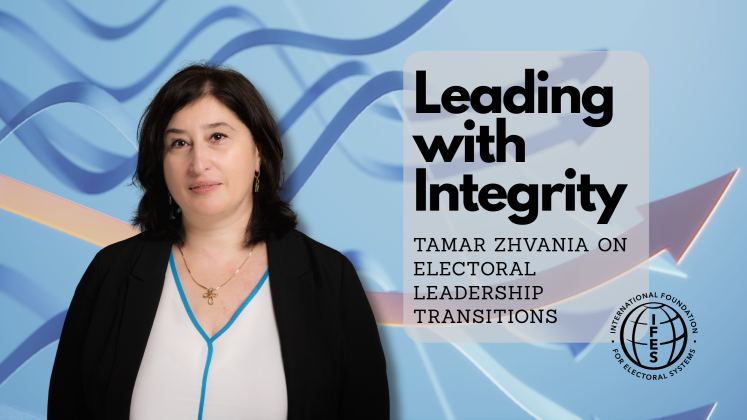
Tamar Zhvania, formerly Chairperson of the Central Election Commission of Georgia, reflects on her transition into that role, shares what made that transition effective, and offers insights for future leadership transitions in electoral management bodies (EMBs).
For nearly eight years, I served as Chairperson of Georgia's Central Election Commission (CEC), leading electoral processes during times of significant political and social change. My journey into this leadership role was shaped by a deep foundation in civil society and international organizations that provided electoral assistance, promoted electoral rights, enhanced democratic culture through voter and civic education, and contributed to accountability, transparency and electoral reform processes.
Throughout my career, I’ve been guided by unwavering principles: honesty, independence, fairness, transparency and inclusiveness. These values helped me not only serve with integrity but also navigate a leadership transition that, while challenging, became an opportunity to strengthen institutional resilience.
In this Q&A, I reflect on the transition into my role, share what made it effective, and offer insights for future leadership transitions in electoral management bodies (EMBs).
In this Q&A, I reflect on my transition into the role of Chairperson:
Tamar Zhvania: When I stepped into the role of Chairwoman, there were a few structural supports in place, but not many tailored specifically to executive transition. The legal framework clearly outlined appointment procedures and responsibilities which provided some grounding. However, there was no formal transition plan or structured handover process.
What proved invaluable was the strong institutional culture and the presence of experienced staff who carried deep institutional memory. These team members, though not officially tasked with facilitating the transition, played a crucial role by sharing context and operational insights that helped me acclimate more quickly.
Additionally, my background in electoral work (particularly in providing technical assistance to the CEC I was joining, and my existing cooperative relationships with its members and staff) helped me adapt and operate smoothly in my new capacity. I also received important support from international organizations specializing in electoral assistance, whose expertise and guidance were vital during the transition,
From the very beginning, I embraced a key principle: leadership is about responsibility, not power. This outlook shaped how I approached my new position: not as a mere managerial task, but as a duty to serve the people and uphold the democratic process with honesty, transparency and fairness. This mindset was essential in helping me navigate the transition with clarity and purpose.
Tamar Zhvania: First, I prioritized listening to staff, stakeholders and the public. Taking time to understand internal dynamics, past practices and existing challenges helped me distinguish between areas needing urgent attention and those requiring gradual reform.
A crucial early action was fostering participatory decision-making. Involving commission members, staff and external stakeholders, particularly on sensitive issues, created a sense of shared responsibility and built trust across the institution. Leadership isn’t about making decisions alone; it’s about bringing others along with you.
Second, I focused on building relationships and trust, both inside the commission and with external partners. Leadership isn’t about commanding from the top; it’s about connecting. Meeting with key personnel, civil society organizations, political actors and international partners helped establish open communication from the outset. I treated all political actors equally, avoiding labels such as “opposition” or “ruling.” This impartial engagement is fundamental to maintaining the EMB’s credibility.
Finally, I relied heavily on professional expertise. A strong grasp of electoral laws and procedures gave me the confidence to proactively defend our work against misinformation and groundless criticism. This knowledge served as a solid foundation for sound decision-making and institutional leadership.
Tamar Zhvania: Continuity and preservation of institutional memory is paramount. This goal can be achieved through establishing documented procedures, planning for clear handovers and maintaining engagement with long-serving staff, and ensures that the institution builds on its progress rather than starting over with each new leader.
Transparency and clear communication, both internally and externally, are essential. These practices foster trust and prevent misunderstandings. All electoral stakeholders should clearly see that the transition is guided by legal norms and democratic values, not political interference.
Respecting the EMB’s independence from political influence is paramount. Incoming leadership should be empowered to act autonomously and without undue pressure.
I also emphasize inclusive engagement and shared responsibility. Involving staff and stakeholders in the transition process reduces uncertainty and reinforces institutional trust and stability.
Lastly, leaders must be proactive and accountable: set your own agenda, confront challenges openly and maintain a calm, confident approach, especially under scrutiny.
Tamar Zhvania: Protect independence fiercely. During leadership change EMBs are vulnerable. Legal safeguards and public support are crucial to ensure that new leadership can operate without bias or external interference.
Transitions are smoother when there is a culture of professionalism and shared values among staff. While leadership may change a strong institution depends on a capable, committed team. Thus, it is also vital to invest in people.
My advice to future EMB leaders in both principled and practical aspects is to lead with responsibility, not power.Your role is to serve the democratic process and the people, not to wield authority for personal or political gain.
Make decisions participatively, but be prepared to act decisively when required. Engage all political actors and civil society with respect and neutrality.
Build deep professional expertise, as it is your strongest shield against criticism and misinformation.
Own mistakes openly. Transparency is a strength that enhances credibility. Be proactive in communication and never leave questions unanswered, even those that seem trivial or are designed to discredit you.
Maintain calmness and confidence in public speaking and interactions; your demeanor sets the tone for the entire institution. Finally, separate your personal identity from your professional role. Let your work speak for itself and never give space for biased or gender-based criticism.
Tamar Zhvania: Transitions are not just administrative events; they are defining moments.
Even with experience, new roles bring new challenges.
It is essential to lead with humility and courage.
Leaders must be ready to learn, adapt and make tough but necessary decisions, always guided by the public interest. When approached with integrity, openness, and courage, incoming leaders can not only protect institutional independence but also reinforce the democratic trust upon which elections depend.
I encourage all current and future leaders to embrace these principles, ensuring that every transition strengthens democracy and public confidence.
Integrity in Leadership
"Own mistakes openly. Transparency is a strength that enhances credibility. Be proactive in communication and never leave questions unanswered, even those that seem trivial or are designed to discredit you."
Electoral Management Body Leadership Transitions
