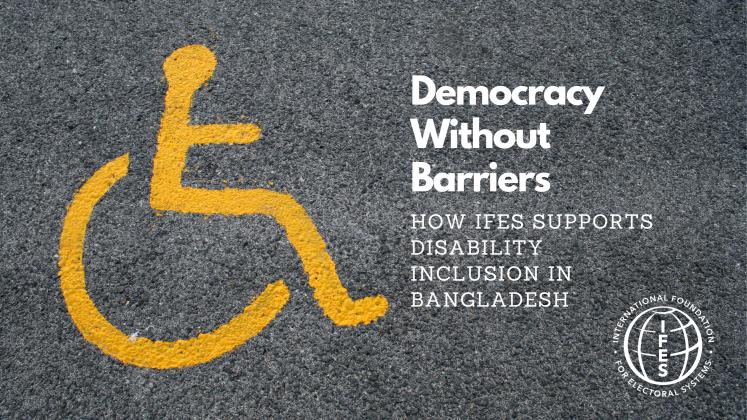
Democracy Without Barriers
Promoting Disability Inclusion in Bangladesh
In the lead-up to the 2026 national elections in Bangladesh, organizations across the country doubled down on their civic education efforts. and the International Foundation for Electoral Systems (IFES) maximized its efforts to support them in that important work. The first free elections in over 15 years, these elections were for many the first time casting a ballot, and it was critical that Bangladeshis did not miss the opportunity to shape the future of their country.
Ahead of these critical elections, persons with disabilities still faced challenges in accessing polling stations and receiving timely information about how to vote. To address this, and with support from the European Union, Foreign, Commonwealth & Development Office (FCDO), and the Swedish International Development Cooperation Agency (SIDA), IFES partnered with the Bangladesh Society for the Change and Advocacy Nexus (B-SCAN) to organize a mock polling station by and for persons with disabilities, providing information on how polling stations function as well as the available accessibility features.
Set up by B-SCAN and led by persons with disabilities, the polling station included an exercise at the entrance to check identity cards and issue voter slips and a private voting station with lowered tables to accommodate wheelchair users and tactile ballots. The station also included a trained sigh language interpreter who explained the steps to vote. There was clear directional signage to help voters easily navigate the path through the polling station, including persons with intellectual disabilities. Persons with disabilities served as poll workers, polling agents, and observers during the exercise, demonstrating what inclusive elections could look like, both operationally and with persons with disabilities serving in diverse election roles.
The exercise also showed that integrating accessibility into the voting process can be practical and low-cost. This includes adding temporary ramps to buildings, posters with voting information and sign language, or portable sound systems verbally describing the voting steps. It also underlined to the importance that accessibility measures have for all voters, including older voters and first-time voters, so they are prepared to enter the polling station – and can do so safely. Reflecting on their experience, participants felt they could comfortably and independently navigate the mock polling area.
IFES Partners with B-SCAN


A History of Disability Advocacy in Bangladesh
Across the electoral cycle, disability rights advocates in Bangladesh have led efforts to make democracy more inclusive. Since 2018, IFES has partnered with advocates and organizations of persons with disabilities (OPDs) to advance their efforts, leading to positive outcomes for diverse communities.
Ahead of the elections, IFES led the dissemination of election-related sign language among Deaf and hard-of hearing voters using its Electoral Sign Language Lexicon, a tool recognized by the Zero Project for its innovation in disability inclusion. IFES worked with members of the Deaf community to develop a Bangla Sign Language lexicon that provides videos and guidance on how to sign common election words and phrases and their meaning. With over 50 election-related terms, the lexicon has reached over 22,000 Deaf people to support their meaningful political participation. The lexicon can also aid election officials and poll workers in more effectively assisting Deaf voters and making polling stations more accessible.
The lexicon is one tool in a long history of disability rights advocacy in Bangladesh. IFES works across the electoral cycle to integrate disability inclusion into civic and political life. IFES’s global leadership program for women with disabilities, Power to Persuade, has been implemented for over nine years for women with disabilities in Bangladesh, including within the tribal communities of the Chittagong Hill Tracts. Through the program, IFES has engaged hundreds of women, among whom many women with disabilities have gone on to lead initiatives aimed at improving their communities. These initiatives have included dynamic and well-attended events around White Cane Safety Day, International Sign Language Day, and the International Day of Persons with Disabilities. Program alumnae have also facilitated seminars on employment opportunities for persons with disabilities, menstrual hygiene management for women and girls with disabilities, and the importance of accessible polling centers. In addition, some women conducted community dialogues with local authorities to advocate for inclusive and accessible public services. These efforts have expanded community engagement and strengthened advocacy for persons with disabilities, ensuring broader visibility and policy discussions at institutional levels.
The national elections might be over, but IFES’s disability inclusion work continues, making progress across the electoral cycle towards a stronger and more resilient democracy in Bangladesh.
This material has been funded by UK International Development from the UK government, the Swedish International Development Cooperation Agency (Sida), and the European Union.
The views and opinions expressed are those of the author only and do not necessarily reflect those of the European Union or European Commission, Sida, or the UK government’s official policies, and no contracting authority can be held responsible for them.