
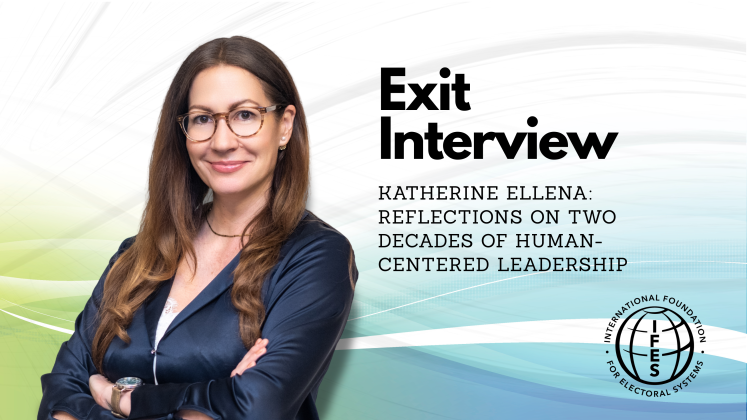
Exit Interview: Katherine Ellena
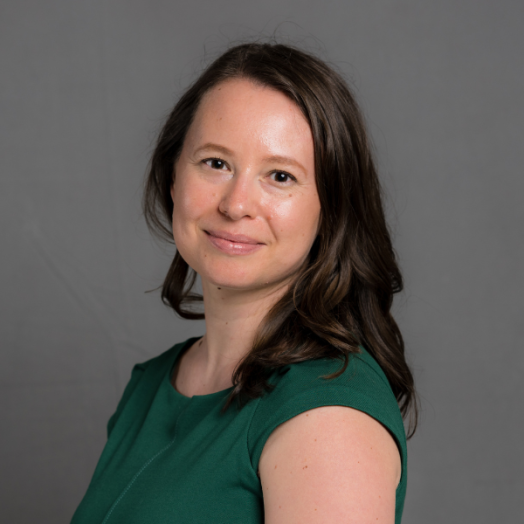
Katherine Ellena leaves a powerful legacy of innovation and programmatic dynamism as she steps down from her role as IFES Vice President for Programs. She first joined IFES to work in the Asia-Pacific region over 20 years ago. IFES is deeply grateful for her dynamic leadership and unwavering commitment to advancing democracy around the world.
Ellena will continue to serve as an IFES consultant, bringing her extensive global experience to IFES’ dynamic range of programming across all regions. We are pleased that Anya Cumberland, IFES Regional Director for Europe and Eurasia, has graciously stepped in to serve as Vice President, Programs ad interim.
As she transitioned into her new role, Ellena sat down for an interview to reflect on both the toughest challenges and most rewarding successes from her tenure with IFES.
IFES takes on some tough challenges, whether charting logistics for remote, hard-to-reach electoral districts, supporting countries that are slipping under water like Vanuatu, or helping secure voter rolls in conflict zones. What has been the toughest country/project you’ve worked on at IFES and why?
Ellena: Every country—whether advancing or backsliding democratically—presents challenges; they just differ in type and degree. The first country I worked in with IFES—India—and the first warzone I entered—Afghanistan—shaped how I approached every assignment afterward.
In India, the sheer scale of democracy puts everything into perspective. Perspective itself is one of the most valuable tools: you can’t solve a problem until you truly understand it.
Afghanistan was different. I left a piece of my heart there. It taught me never to accept the belief that change is impossible. Democracy, at its core, lives in the hearts of individuals.
IFES has worked in a lot of environments transitioning out of (and sometimes into) conflict. I’m thinking of the eruption of civil war in Sudan, the coup in Myanmar, violence in Haiti and DRC, and the full-scale invasion of Ukraine. All of these involved the emergency movement of staff and operations. What is your secret to effective crisis management?
Ellena: I’ve always believed IFES should be able to work everywhere, in some form, as long as we can manage risk effectively.
The truth is, there’s no secret to crisis management—it’s just preparation. In elections, one of the biggest mistakes is failing to plan for contingencies: power outages, ballot shortages, false polling information. If you anticipate them, they rarely become full-blown crises. The same is true for security. Most emergencies can be foreseen and rehearsed, so when they happen, you have the muscle memory to respond quickly and effectively.
And above all, security must be human-centered. We’re not only protecting assets—we’re safeguarding people. The heart of IFES has always been our national staff. They live through the conflicts, and yet they stay, working tirelessly to make their countries better.
What is one piece of advice for future Vice-Presidents at IFES?
Ellena: Never forget how fortunate you are to work alongside some of the most dedicated people in every corner of the world.
And don’t forget to laugh—because, as Mark Twain said, “Against the assault of laughter, nothing can stand.”