
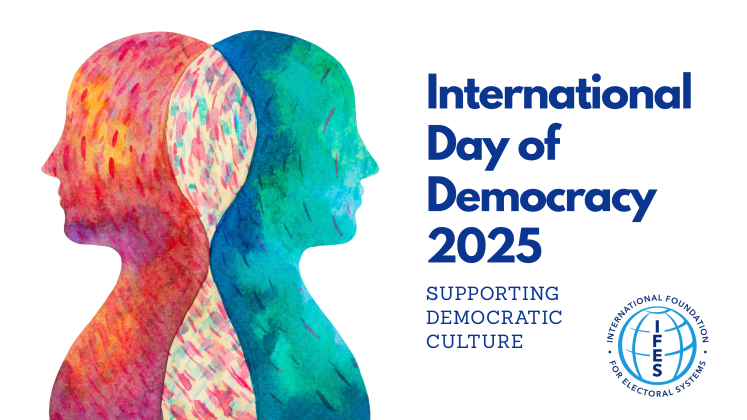
International Day of Democracy 2025
Today we celebrate democratic culture, a process of constant calibration and recalibration of people’s relationships with each other, with their communities, and with their governments.
International Day of Democracy: Building Democratic Culture
On the International Day of Democracy this year, we are reflecting on what it takes to make democracy “work.” We believe that democracies thrive when people:
-
can access accurate information about their governments;
-
have space to safely hold competing views;
-
are able and willing to peacefully debate with their fellow citizens, candidates, and officials; and
-
have opportunities to engage in civic action to hold their governments accountable.
Each of these components is underpinned by a culture of democracy. A person's choice to engage in democratic forms of government is enabled by a shared understanding of democratic principles and rights.
The current moment presents an opportunity to reimagine international democracy support by centering people as the owners and defenders of democratic culture. The way to build democratic culture is to truly collaborate with local organizations and local communities and the individuals who make up those communities. This collaboration must begin in the places and spaces – online and in person – where people already come together.
Building on four decades of innovative research and productive partnerships with civil society, independent institutions, political leaders, and government, the International Foundation for Electoral Systems (IFES) is engaging in a new concerted effort to bolster democratic culture. We are particularly focused on the places around the world where authoritarianism, polarization, and conflict threaten to further distance ordinary citizens from their rights and responsibilities as guardians of their country’s future.
What is democratic culture?
Democratic culture is the shared values, norms, and behaviors, that shape how individuals understand and exercise their rights and responsibilities toward one another, their elected leaders, and their government. Democratic culture is exercised at every level of society, from individual beliefs and practices to community actions and national movements. It requires active citizenship: individuals who feel a stake in the future of their community and country, and are willing to engage constructively to secure that future. Democratic culture also requires respect for individual human rights, including respect for those who hold and express minority and competing views.
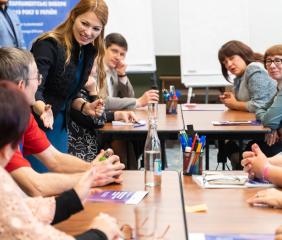
Democratic culture is a process of constant calibration and recalibration of people’s relationships with each other, with their communities, and with their governments. Building democratic culture is the work of ordinary citizens where they live, work, learn, and worship; encouraging respectful participation around the issues that matter to them; and cultivating the practice of peaceful discussion, understanding, collaboration, and action.
We are inspired by the story of Lilit Petrosyan, a young woman from the small town of Argina in Armenia. While studying at the Armenian National Agrarian University, Lilit took a course on “the Engaged Citizen.” This semester-long civics course developed by IFES expanded her understanding of how she could engage with her neighbors and her local government, to the benefit of everyone in Argina. Read her story here.
What’s next?
For IFES, a focus on democratic culture is a logical and essential extension of our mission statement: together, we build resilient democracies that deliver for all. Drawing on our research and programming in 145 countries, technical expertise, and broad networks across civil society and government, IFES is working to deepen our understanding of existing best practice, map where targeted support can be most effective, and connect people within and across borders working to advance freedom and democracy. IFES has already surveyed hundreds of young people around the world about civic engagement, interviewed local activists about what democracy means to them, and taken a deep dive into civic culture in Honduras.
Our dedicated focus on democratic culture builds on this work and brings together IFES’ deep experience on formal civic education, leadership training for women in civil society and politics, activism training for young people and persons with disabilities, peacebuilding and conflict mitigation, and supporting access to and dissemination of accurate information.
It is our hope that IFES’ work can inspire and bring together men and women; young people, elders, and the generations in between; traditional and religious leaders; and everyday citizens. And in the process, it is our hope that IFES can play a meaningful, supporting role in the work of peoples building free, peaceful and prosperous democratic societies.