




3.3 Handling Issues of Noncompliance

Even when you, as an oversight institution, provide exemplary advisory services, there will be times when the rules might be broken.
The nature of the rules and the mechanisms for dealing with rule breaking vary from country to country depending on whether the law provides for criminal or administrative approaches (or both), and on whether you have the power to conduct administrative and criminal investigations, impose civil sanctions, and/or bring criminal prosecutions. In some countries, the political finance oversight institution must pass criminal matters to the police for investigation, after which the courts may take action.
In a criminal [criminal-law?] regime, breaking the rules normally leads to “offences.” There are many terms for non-criminal rule breaking depending on the country and the regime, such as “violation,” “breach,” and “noncompliance.” We will use the term “breach.”
It is essential that any oversight regime include methods by which potential breaches of the rules can be pursued and, where appropriate, action taken. Without a robust mechanism to deal with breaches, there is little incentive to comply and no deterrent to those who wish not to do so.
Whatever the regime, the mechanism generally has two elements:
- Investigation—steps taken to establish to the required level of proof for whether a breach has occurred.
- Enforcement—deciding and implementing the action to be taken where a breach has occurred.
You must have in place policies and procedures to ensure that the steps you take in pursuing and actioning possible breaches are, and are seen to be, impartial and consistent. This is not just to ensure individual cases are successfully handled but also to protect the legitimacy of the oversight body, because public trust will be undermined if there is a credible suspicion that you are not completely impartial.
Handling breaches can be broken down into distinct stages:
- Triage (deciding whether to investigate a matter).
- Investigation planning.
- Gathering evidence.
- Record of evidence.
- Assessment of evidence obtained.
- Reaching conclusions on the facts.
- Decision on whether a breach has occurred.
- Decision on action to be taken.
Here is a flowchart showing how these stages can work:
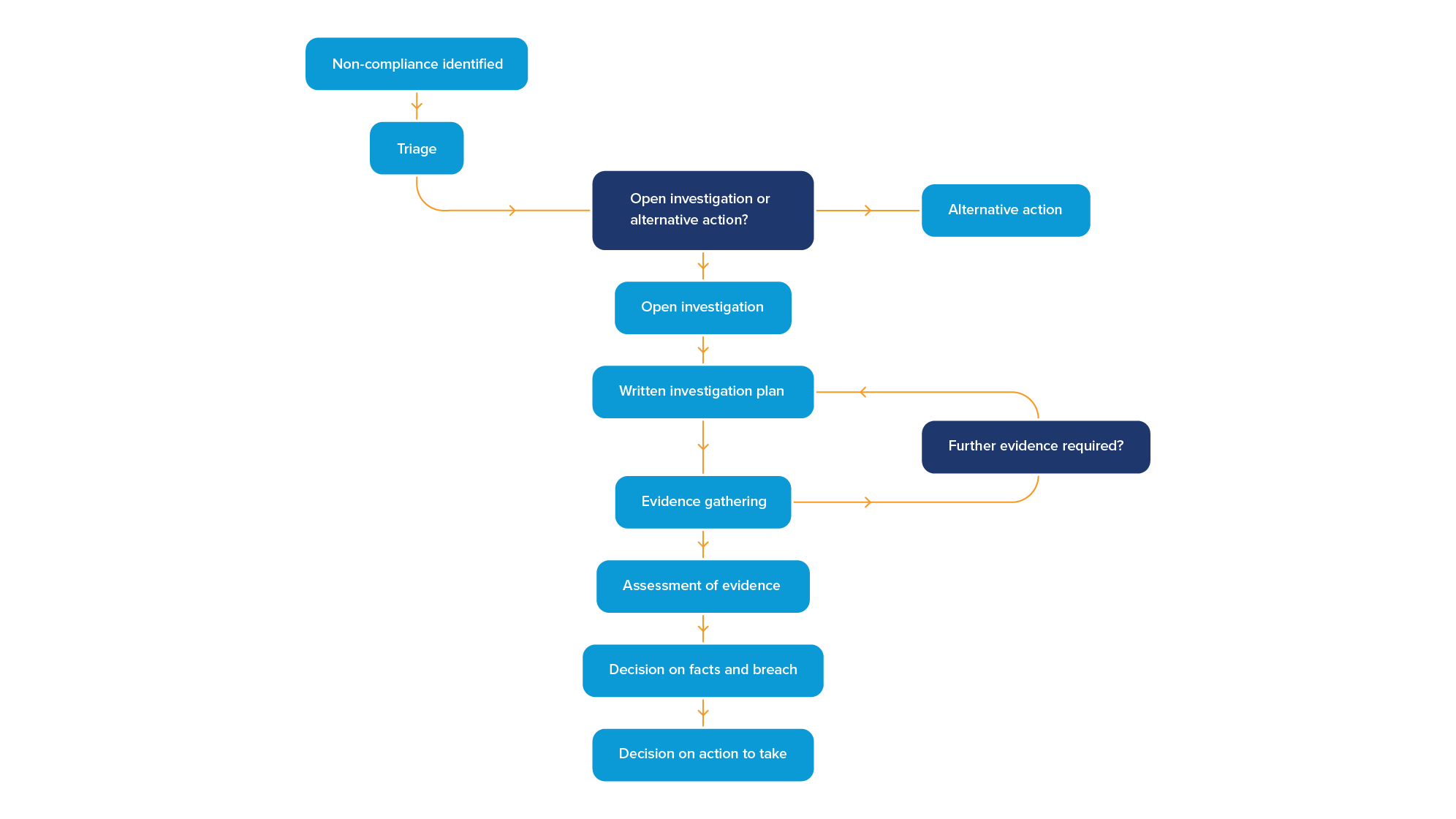
Investigation and enforcement action should be separated as far as possible if you do both. Different parts of the organization, or different people, should independently decide whether a breach has occurred and, if yes, what action to take.This separation of decision-making is not always a legal requirement, but it helps avoid suggestions that the final decisions were unduly influenced by the views of the investigator(s) and is in keeping with the general legal principle that one cannot be both judge and jury. There should be some formal avenue for the person/entity being investigated to have the opportunity to challenge the evidence and recommendation of the investigators as well as to present their own evidence and arguments to the decision-maker. This can be done on paper or in a formal hearing. It is highly recommended, especially in countries where investigations and sanctioning decisions are not undertaken by different individuals, that there are clear rights of appeal, either to a higher-level official or to a court.
Investigations General Principles
For detailed information on how to carry out electoral investigations, see the IFES Election Investigations Guidebook: Standards, Techniques and Resources for Investigating Disputes in Elections.
The purpose of an investigation should always be to establish the facts in order to reach a view on the evidence. It should not be based on any desire to prove anyone is innocent or guilty, and it should not assume or care what the facts will prove to be. You should gather relevant evidence and consider it impartially, and be fair to everyone. In this way you will reach conclusions that are objective and evidence-based. For the same reason, it is important that investigations are conducted by appropriately trained officers and without political influence or interference. There are three main ways an oversight institution’s own actions might undermine an investigation:
- By not conducting the investigation properly or competently.
- By conducting the investigation in a biased rather than objective or impartial manner.
- By taking too long or by rushing the investigation, and therefore being unfair to those involved.
To conduct an investigation that will lead to the right outcome and avoid potentially successful legal challenges to your decisions (see Avoiding successful challenges to investigations.pdf), your investigation should meet the following criteria:
All of the relevant evidence is obtained properly: That means in accordance with any statutory powers and all relevant domestic laws (for example, relating to human rights, equalities, and use of data).
Everyone involved is treated fairly: That means consistently while also recognizing each individual’s needs or circumstances; you will want to avoid perceptions that public officials or officeholders receive preferential treatment because of their positions.
The evidence is considered objectively and without any bias by a specialized staff: Everyone who works on an investigation must be able to declare that they have no conflict of interest, so that they can show they are not biased. If there is any conflict of interest, a person should not work on the case (see U.K. Electoral Commission’s conflicts of interest template for investigations.pdf).
The investigation is conducted in a reasonable time, enough to ensure the conclusions are sound, but no longer: Different investigations will need different amounts of time, but all should be completed as quickly as they properly can be.
The investigation complies with all relevant legal requirements, policies, and internal procedures of the oversight body.
That last point is vital. If the investigation does not comply with the relevant legal requirements, it is unlikely to survive a challenge. And every step, from your decision to open the investigation to the final conclusions, should be documented in accordance with your institution’s written procedures. Having an “audit trail” (for example, a contemporaneous record of decisions and actions and the reasons for them) is critical in case the investigation is challenged.
Triage—Deciding Whether To Investigate
Matters that could become investigations can arise from any of the compliance control mechanisms the oversight body operates. Regardless of source, it is good practice, unless prohibited under domestic legislation, to conduct a triage exercise when deciding whether to open an investigation into a potential breach. Remember that the person doing the triage must have no conflict of interest, as they are affecting a decision about a possible investigation. The triage usually involves a basic assessment of the matter to establish whether there is a case to answer and whether an investigation is warranted. Factors may include:
- Would the allegations, if proved, constitute a violation of the law?
- Is there sufficient evidence to justify an investigation?
- Is it appropriate to investigate? In some countries this can involve what is known as a “public interest test.”
- Whether it is appropriate to investigate can involve a number of considerations, and you will need to consider every case on its own facts, but some common factors that might be relevant are:
- The seriousness of potential breach: Was it deliberate? Was a significant sum involved?
- The compliance history of the organization: Is this the first time there has been a potential breach?
- The responsible officer being absent and a less experienced officer trying to help but making a mistake.
- Illness or even death of a responsible officer, which was a direct cause of the potential breach.
- The time that has passed since the potential breach: The more time has passed, the less an investigation might be able to achieve, although efforts to hide a breach or delay an investigation should not be rewarded.
- The cooperation of the organization: Did it self-report the issue before it became public? When notified of the issue, did it immediately apologize and seek to put things right?
In some situations, there may be other, more appropriate ways to deal with the matter, such as providing guidance or issuing a warning, but it will always depend on all of the facts.
For example, where a new political party delivers a donation report in which some figures are slightly wrong, it might be appropriate to provide some guidance rather than open an investigation. On the other hand, where a political party appears to have deliberately tried to hide an illegal donation of substantial value, an investigation is much more likely to be appropriate.
Planning an Investigation
It is recommended to produce a written plan for each investigation and highly recommended in the case of complex cases—an investigation plan template is available here (see Investigation plan template.pdf). Your investigation plan should set out what is going to be done and how. Your plan should show that all of the key issues were considered appropriately from the very beginning. It does not always need to be very long or detailed, but it should set out:
The scope of the investigation:
- What specific potential breach(es) are you investigating? What standard of proof applies?
- What evidence do you require to establish whether the potential breach(es) occurred?
- Where can you obtain that evidence?
- How will you obtain the evidence? What powers can you use, and is it appropriate to use them or to use a voluntary approach, if this is recognized as an option in your jurisdiction?
- In what order might you want to obtain evidence? It is common to gather physical evidence first, and then consider getting explanations or testimony.
Remember that any person who works on the investigation should declare that they have no conflict of interest. That includes decision-makers, not just people gathering evidence. For inspiration, see the U.K. Electoral Commission’s conflicts of interest template for investigations.pdf.
Gathering Evidence
The conclusions of an investigation must be based on evidence, not suggestions or speculation. Evidence is generally any material that can help to establish facts. In some jurisdictions, the evidence must also be admissible in a court of law. In other jurisdictions, inadmissible evidence falls within the scope of investigation if it could reasonably lead to admissible evidence (for example, using a statement from an anonymous source to lead you to admissible evidence). Many jurisdictions impose requirements that all evidence be obtained lawfully. This highlights how important it is that everyone involved in conducting investigations is well-trained in the applicable law in your jurisdiction.
There are generally four types of evidence:
- Physical documents: For example, bank statements, notes of meetings, or letters.
- Digital evidence: For example, emails, digital images, or text messages.
- Other physical evidence: For example, campaign items like banners or flags.
- Testimony from witnesses: Usually records of interviews.
The most common type of evidence in political finance investigations is physical documents, but digital evidence is quickly becoming more common. Testimony from witnesses can be important in providing more information about physical evidence or in recalling events.
If you have planned the investigation well, the evidence-gathering phase should be mostly a matter of following your plan. However, your plan may change or expand as the investigation advances. As evidence is gathered, you may identify new or further evidence you need to obtain—it is important to be ready to adapt the investigation when that happens. You need to record changes to the plan, and there are different ways to do this. For example, you can update the investigation plan throughout the course of the investigation, or you can instead make a separate record of actions and decisions after the plan was made, which shows how the investigation changed. In some cases, that might involve identifying new and different breaches to those that led to the investigation. Depending on the relevant laws or policies in your jurisdiction, you may need to consider whether the scope of the investigation should be expanded to include them and, if so, whether you need to notify the person or organization being investigated.
You should conduct all evidence gathering in writing so that there is a clear record. If you are using a legal power to require the production of evidence, you must comply with all relevant requirements for use of the power.
Documentary and Other Physical Evidence
Draft requests for evidence carefully. You need to frame them objectively and clearly, explaining any words or terms that may be open to interpretation and specifying the period covered by the request. The requests should be broad enough to cover all forms (digital and hard copy) and all non-identical copies of the original documents (copies with handwritten notes). It is a good idea for the request to advise what the recipient should do if they have doubts about disclosing any material. For example, in some countries legal advice is exempt from disclosure on the grounds of “legal professional privilege.” One option is to require a brief description of material not being disclosed and the reasons for it being withheld; another is to require the recipient to contact you if they have any doubts about whether material should be disclosed.
You should specify how the evidence is to be produced—for example, is it to be sent to you in hard copy or electronically, or made available for inspection elsewhere? Finally, you should set a deadline for responding that is reasonable to the request (for example, a request for massive amounts of documents may require considerable time whereas a request for a single, readily available document may require only a minimum amount of time to produce). Although reasonable deadlines are important and generally should be met, you may offer to consider a request for more time if good reasons are presented to justify the request.
Digital evidence can produce unique challenges. It is easy to take screenshots, for example, but it is also easy for material to disappear or to be manipulated. You therefore need to take particular care in establishing the reliability of digital evidence.
Testimony from Witnesses
Obtaining testimony from witnesses, or from the subjects of investigations, is best achieved through interviews. Generally, it is best to interview individuals only after obtaining all documentary or physical evidence, so that it is clear what you wish to discover from the interview. In some cases, it may be helpful to ask witnesses to provide answers to written questions before an interview to establish simple facts (for example, dates and times of meetings, or names of certain people). Answers to these types of questions can help the investigator prepare for the actual interview and thus make it more focused and productive.
Your approach may differ depending on the person being interviewed, but some general principles apply to all interviews:
- An interview is a way of gathering evidence and needs to be planned carefully and conducted professionally.
- It should have a clear purpose.
- Interviews should always be recorded or documented.
Some more detailed guidance for interviews can be found here: Interview guidance.pdf.
Records of Evidence
Just as it is vital to have a record of the actions and decisions you have taken during an investigation, it is also critical to maintain a record of all of the evidence acquired during the investigation—when it was obtained, from where, and how. This is sometimes called a schedule (see Evidence schedules template with example content.pdf). This can be a simple spreadsheet in many cases. Each piece of evidence should have a unique reference and a brief, factual description. This includes interview records.
Record keeping takes time and effort; it is reasonable for the level of record keeping to reflect the complexity or seriousness of the case. For example, it may not be necessary to create a schedule if there are only four pieces of evidence. The essential point here is that an accurate record makes it harder to challenge the evidence, as well as making the administration of the investigation easier.
Assessment of Evidence
Once the initial evidence gathering-process is complete, it is important that you review all the evidence. This enables you to establish first whether there is enough evidence to reach a view on the facts or if you require further evidence, and second which facts are confirmed by the different sources of evidence and which appear to be disputed. If further evidence is needed, it should be obtained at this point.
Reaching Conclusions on the Facts
Once you have gathered all relevant and obtainable evidence, you can decide what the facts are; in other words, what you have decided happened.
There will generally be some agreed facts. Agreed facts are ones that all of the evidence supports. For example, if money was transferred from person A to person B, and both persons agree that this happened, and there are bank records showing it, that is an agreed fact. Agreed facts can be accepted without further work. If all of the facts are agreed, you can decide what happened straightaway and proceed to determine whether the facts support a finding of breach or no breach.
However, there will usually be disputed facts where all of the evidence does not support one view. For example, person A says they gave money to person B in cash, but person B says the money was never given, and no bank record exists to prove the situation.
Disputed facts mean you need to decide what really happened. Reaching a view on disputed facts always depends on the specific circumstances, but some general approaches are often used:
- Weight of evidence—if a significant majority of the evidence indicates one view and only a small minority indicates another view, the majority may be more reliable.
- Quality of evidence—if two witnesses describe something differently, but one was in a better position to describe it (for example, one was at a meeting but the other was only told about it), that evidence may be deemed of better quality.
- Reliability of evidence—if two witnesses give different evidence but there are reasons to doubt the evidence of one (for example, other evidence they gave has been shown to be inaccurate), the more reliable witness may be given precedence.
These factors are merely illustrative, and there will be many other ones you need to consider, in particular when deciding how to resolve disputed facts.
Once you have identified all the agreed facts and reached a view on any disputed facts, you have decided what transpired in relation to the allegations. You now must weigh the evidence against the relevant standard of proof that must be met to reach a decision for each potential breach on the specific facts of each. Where your decision rests on disputed facts that are finely balanced, that may have an impact on whether the standard of proof can be met.
You should set out your decision on each potential breach in writing. This may be in a report, a legal notice, or some other form. Whatever the form, it is important that:
You set out the findings of fact, along with the analysis of the evidence that has led you to find those facts.
You then apply the facts to the required elements of the potential breach(es) or offences with analysis of whether they have occurred.
Your findings should be accompanied by supporting documents, such as a schedule of evidence and a record of actions and decisions taken during the investigation.
The subject of the complaint should be afforded the opportunity to review the proposed findings and supporting documentation, and to put forward evidence and/or arguments in opposition to your conclusions. The exact nature of what the subject is provided with, and at what stage, may be set out in law or, if not, should be included in your institution’s policies/procedures, to ensure consistency.
Enforcement
General Principles
Where an investigation identifies a breach and the responsibility for taking enforcement action lies with the oversight body, you should have a separate process to consider the facts of the case, take into account all relevant factors, and reach a decision on the appropriate enforcement action to take.
As with investigations, any person who works on the enforcement action should be able to declare that they have no conflict of interest (see the U.K. Electoral Commission’s conflicts of interest template for investigations.pdf).
To show that enforcement action is not taken simply for its own sake or for party-political reasons, it is helpful to have clearly defined objectives for the actions you take when breaches are identified. As far as possible, you should publish those objectives, so that those who are subject to regulation and the wider public can see them.
Elements that should be considered:
- Objectives of enforcement action.
- Proportionality.
- Relevant factors to consider.
- Types of enforcement action.
Objectives of Enforcement Action
It can be helpful for the oversight institution to have objectives for enforcement action. These could be published. Objectives can provide the basic justification for enforcement action to avoid the suggestion the institution is just taking action because it is biased against a party or individual. Any action should be intended to achieve at least one of the objectives. You should establish your own appropriate objectives in terms of enforcement action based on the relevant law and priorities of the oversight institution, but some examples might be:
- To ensure that confidence in the regime is maintained.
- To eliminate any benefit gained from a breach.
- To deter further breaches by the organization in question, and by others as well.
- To seek fair and impartial enforcement when the law is violated.
Proportionality and Deciding Which Factors To Consider
Any decision on enforcement action should take account of the principle of proportionalityâthis means taking enforcement action that is appropriate and will achieve your objectives, but not action that goes beyond that. Disproportionately strict enforcement action risks challenge, creates the appearance of partiality or inconsistency, and can be a blow to political pluralism. It should in all decisions be remembered that, as the Venice Commission argues, âPolitical parties are critical institutions through which citizens organize themselves to participate in public life, among which they choose at elections, and through which elected officials cooperate to build and maintain the coalitions that are the hallmark of democratic politics.â On the other hand, disproportionally light sanctions may signal to political actors that they can violate regulations without significant consequences. This can be particularly noticeable in cases where receiving large prohibited donations can only be sanctioned by small, fixed fines.â¯
One recommended approach for ensuring that proportionality is respected, if the relevant law allows, is to prescribe ranges of actions or fines for particular types of breaches or violations. Alternatively, you can consider each case individually and begin by looking at the least severe form of action first to determine whether it meets your enforcement objectives. If not, then move on to the next level of action, and so on until the level is reached at which the relevant objectives are likely to be met. You should always consider taking no enforcement action at all as the first optionâas there may be instances when no action is necessary to achieve your enforcement objectives. For example, where a new party makes minor inadvertent errors in, for example, a donation report, you may be able to achieve your objectives by providing guidance to the party, without the need for other action.
Deciding on the most appropriate action will always depend on the specific circumstances of a case, and no two cases are likely to be identical. It is not therefore possible to set out all of the factors that will be relevant in any particular case. Below, however, are some that will often be relevant. As with objectives, it is helpful to publish these in the interest of transparency. Assuming that this is permitted by legislation, you may wish to take into account some or all of the factors below (reproduced from the American Bar Association Standing Committee on Election Lawâs International Election Remedies, Chapter 10: âCampaign Finance Remediesâ).
| Consideration | Proportionality Guideline |
|---|---|
| The monetary amount involved in the violation | Receiving a very large prohibited donation should carry a tougher sanction than receiving a small donation from the same source. |
| The impact of the violation on democracy and public confidence in the political system | A technical infringement with no direct effect should carry limited sanctions, while widespread violations (such as vote buying) that threaten the fairness of an election should carry severe sanctions. |
| Gain resulting for the violator | Any gainâfinancial, electoral, or otherwiseâresulting from the breach |
| If the violation was committed intentionally | While ignorance of the law may not be an acceptable defense, intentional violations should be sanctioned more severely. |
| If attempts have been made to hide the violation | Actors who report possible (minor) violations themselves should not be sanctioned, if there was no intent to violate the law. However, those who have attempted to hide violations should be sanctioned more severely than those who have not. In addition to whether the actor reported the potential violation, the level of cooperation shown during an investigation may also be taken into account. |
| If the violation is a repeat offense | Actors who continue to commit violations should face more severe sanctions. |
| If the actor has refused to abide by earlier ruling | Actors who refuse to abide by earlier rulings (for example, to return a prohibited donation) should be sanctioned more severely. |
| Possible detrimental impact on the democratic process or pluralism of imposing the sanction | In some cases, a remedy may be appropriate based on the severity of the violation and its potential impact on public confidence in the electoral system, but imposing the remedy would negatively impact the democratic process (for example, if imposing a particularly large fine would bankrupt a political party). |
Types of Enforcement Action
The available options will depend on the local regime, which may vary significantly. Sometimes the legislation will set out specific enforcement actions for various breaches; in other instances you may have discretion to determine the type of enforcement action to take. In general, the two most common types of enforcement action are fines and powers to require particular action (for example, return of donations or improvements to systems). We will call these “directions.” Depending on the regime, it may be possible for you to use fines and directions in combination, or it may be a matter of choosing between them.
In some regimes, where there is significant public funding of political parties, another option might be suspension or disqualification from receipt of public funds for a period of time. In some regimes an individual who commits a breach or offence might be barred from holding office or being a candidate for elected office for a set period. Where political parties or other organizations must be registered, another possible option is removal from the register. Deregistration is a very serious action with potentially severe consequences for political pluralism and, if it is an option in your jurisdiction, it should be used only in the most exceptional of circumstances.
Directions
Directions requiring specific actions to be taken can be helpful in ensuring that any loss of transparency is corrected, as well as in requiring organizations to improve their systems and procedures. Similarly, requiring the training of officers or requiring periodic audits are options that can lead to better compliance in future. When using directions, it is essential to ensure the required actions are very specific, clearly explained, and subject to a set timescale. The failure to comply with a direction should generally lead to some further form of enforcement action.
Fines and Levels of Fines
Fines can be helpful in deterring further breaches for the subject of the investigation in question and for others. They may to some extent help to eliminate any benefit from the breach. They are unlikely, however, to ensure that any loss of transparency is corrected. There is also a danger that where a breach arises from neglect or other inadvertence, a fine could mean the organization spends money paying the fine that could have been invested in improving compliance. Of course, where the breach involves illegal funding or expenditure, fines exceeding the illegal amount (coupled with disgorgement, where appropriate) may be necessary to avoid the penalty being seen as just the “cost of doing business.”
The local regime may set specific fines for particular breaches, or it may set a range of monetary penalties with a maximum level fine that can be imposed. Where there is a range, the oversight body will need to establish criteria for determining the level of the fine to be imposed. In some countries, it may have a set formula for calculating fines. In the United States, for example, the Federal Election Commission has published a penalty calculator for late submitted reports. This can be helpful for routine violations that are easily quantifiable and result from genuine mistakes or oversight. In other countries, such as the United Kingdom, the oversight body determines the level using the same proportionality approach as set out above to ensure that the level of fine is enough to achieve the relevant objectives, but not more.
Decisions
As with investigations, you should make a clear and detailed written record of your decision and the reasons for it, with all relevant analysis. The record should show that all relevant factors were considered, including all of those included in any policy or procedure of your institution. Where a factor was not considered relevant, you should record this as well.
Imposing Directions and Fines
The local regime may set out procedural requirements for imposing directions and fines, which you must comply with to avoid challenges. If you have discretion, it is important that the subject of the direction or fine be given an opportunity to challenge or make representations on the decision to make the process open and fair. This may involve an opportunity to comment before the decision is finalized or a right of appeal afterward, or both. In some regimes the right of appeal is to the courts or another body than the oversight institution, which adds a further check to the oversight institution’s decision.
Publicizing Investigations and Enforcement Action
A challenging question concerns what information you should disclose about investigations and enforcement.
It may sometimes be appropriate to make public the opening of investigations, but there are also risks to the integrity of the investigation and questions of fairness to the subject(s) of the investigation. However, even where the start of an investigation is proactively made public or confirmed in response to press inquiries, it is good practice not to disclose any information about it while it is in progress. Such disclosure increases the risk that information in the public domain may lead to evidence being altered or destroyed, or to witnesses being reluctant to provide evidence. It also increases potential prejudice to the subject(s) (in particular if done before Election Day). You may also find yourself having to spend time responding to press questions about the investigation rather than carrying it out.
It is good practice to make public the outcomes of investigations, whether a breach is found or not and whether enforcement action was taken or not. It is beneficial to be transparent about your enforcement actions for which you should be accountable. This type of transparency in essential to fostering the public’s confidence that matters are properly investigated, that reasoned decisions reached, and that those who fail to comply with the law are held to account. Finally, since enforcement action is intended to deter noncompliance by others, it is necessary for them to know that action you have taken against wrongdoers.
It is highly advisable to have a well-developed, published disclosure policy to address what information you will release about investigations, when you will release that information, and in what form. Such a policy will ensure there is clarity and, provided you adhere to the policy, it can help negate allegations of bias or unfavorable treatment.
The U.K. Electoral Commission’s disclosure policy is published as Appendix B to its Enforcement Policy.
Toolkit Navigation
Overview of Oversight, acknowledgments, and author information.
The glossary provides definitions for terms used throughout the Oversight.