Chapter 4: Potential Tensions
4.1. Overview
This section discusses the phenomena, policies, and characteristics that are (or could be in the future) sources of tensions between Ukrainian refugees and host communities. It is important to stress that, at the time of writing, these had not necessarily harmed community cohesion. However, they could do so in the medium term— for example, should contextual factors change or should disinformation actors take intentional actions be taken to magnify the tensions. This chapter notes the specific types of risks related to each aspect of the refugee journey, how they have manifested to date, and signs pointing to the likelihood of the tensions becoming more significant.
While the overall risks are generally low, the risk ratings below are in relation to the risks to community cohesion in each country. This means that a tension noted as ‘relatively high risk’ might still be unlikely to materialise, but it is likely to be a higher risk than other tensions in that country. For example, tensions around the generally lower benefits received by TCNs not eligible for TP are unlikely to significantly threaten community cohesion given the very small number of such TCNs in the region; on the other hand, economic concerns are widely felt by the host and refugee populations.
TABLE 4. Potential sources of tensions between Ukrainian refugees and host communities


4.2. Legal status, welfare, and benefits
Perceptions that Ukrainian refugees abuse the benefits system (e.g., cross the border just to get money): In the research workshops in Moldova, Romania, and Slovakia, there were discussions about Ukrainian refugees potentially abusing the benefits system by living in Ukraine and claiming support in other countries. There have been border crossings between Ukraine and its neighbours in both directions. For example, by November 2022, 370,918 Ukrainian refugees and TCNs who had entered Moldova had crossed back into Ukraine.434 Many of the Ukrainians (46 percent) intended to return home for a short visit and then either return to Moldova or migrate onward.435 Ukrainians expressed that they made these trips to reunite with family members (60 percent) or collect their belongings (46 percent),436 but some Moldovans perceived them as efforts to claim benefits in Moldova while living in Ukraine. Under the changes introduced by the TP directive, remaining outside Moldova for more than 45 cumulative days between 1 March 2023 and 1 March 2024 would invalidate TP status, and the individual would lose the right to work and access key public services in Moldova.437 In several countries, including both Slovakia and the Czech Republic, claims of abuse of the benefit system related in part to Ukrainians not generally fitting conventional narratives or stereotypical images of destitute refugees. The perception that Ukrainians abused benefits also aligned with the narrative that the war is not active across all of Ukraine and that Ukrainians should either stay in those regions or fight for their country from Ukraine.438
Unknown, unclear, or bureaucratic procedures to register for TP and services; (perceived) lack of information on the rights and obligations of people with TP status: In each of the five countries, a TP directive was initiated to ensure Ukrainians are appropriately registered. However, Ukrainian refugees noted a lack of clarity around TP and the service registration processes. Lack of clarity about the procedures is likely to be compounded as TP frameworksâwhich were generally intended to cover a period of one yearâwere extended and reregistration is required.439 In the case of Moldova, the TP process was introduced in March 2023, whereas previously refugeesâ stays were extended every three months and came under the countryâs state of emergency legislation. Workshop participants indicated that a lack of clarity around the procedures had raised concerns among Ukrainian communities.440 Specifically, this related to which documentation would be required to obtain TP status, the availability of in-person appointments at the General Inspectorate of Migration, and the ability to access legal assistance.
One workshop participant shared her account of visiting the information office to ask where she could access some required documentation to register for TP (specifically, an attestation of place of residence) that was not required previously. An employee didnât know and treated her dismissively, saying she needed to figure it out herself.441
Given language barriers and other factors such as location and access to technology, it is possible for Ukrainians to slip through the cracks and lose their legal residence status. In the Czech Republic, workshop participants mentioned that this could be a particular risk for youth ages 16 to 17 years who do not have legal guardians and might therefore not re-register process, thus becoming more vulnerable and more easily exploited.442 Ukrainians who do not understand the bureaucratic processes may feel unwelcome, and host communities may perceive refugees as not conforming with required procedures.
Parallel infrastructure created to state institutions: The creation of parallel support systems for Moldovans and Ukrainians was discussed throughout the Moldova workshops, often inflected with the assumption that NGO- and multilateral-supported services for Ukrainians were superior443 (often with significant or even greater funding than some pre-existing government structures). For example, in 2022, over $200 million USD was dedicated to support for Ukrainian refugees in Moldova.444 This equates to approximately $1,868 USD for each refugee in Moldova in the medium to long term. This spending takes place in a country with limited financial resources; as an illustration, per capita expenditure on health for Moldovan citizens is only $284 USD per year.445 Some humanitarian actors aim to work through the government system; for example, the World Food Programme aims to use Moldovan social protection systems to provide support.446 Working through national systems is important both to avoid creating parallel infrastructure and the potential perception that refugees are receiving more or better services and support. Although the concern was mentioned only in Moldova, efforts to streamline provision of aid and ensure that state structures are strengthened through the refugee response may also help to address underlying equity issues.
Differences in provision of welcome and support to refugee or migrant groups not from Ukraine: Ukrainian refugees benefit from a regime that differs from those faced by other groups. Specific protections were set up for Ukrainian refugees, and the process to access these protections was easier than those available to other groups. This was the case across all five Central and East European countries.447 For instance, in Poland and Slovakia, non-Ukrainian asylum seekers are restricted from the labour market for the first six months while the decisions on their applications are pending.448 Though this would concern a small group of people, workshop participants noted that it could create resentment among other refugee groups that did not receive such treatment (and experience associated tensions), as it can be perceived as unfair to them.449
Government or NGO funding that is allocated specifically, and for a long period, to support Ukrainians can be a source of tension: Participants in the Slovakia research workshop commented on a suddenâand visibleâavailability of funding to support Ukrainian refugees.450 Such support, while valuable, can create tensions, particularly if it is perceived as exclusively for the assistance of Ukrainians, without providing benefits or additional funding for Slovak citizens in need (such as single mothers, people facing homelessness, or people in poverty).451 This tension was linked to the discourse that ârefugees are better supported than the host population, and that such support comes at the expense of funding for the host population.â452 Workshop participants added that, for Slovak citizens, achieving a good quality of life on benefits was challenging and that, should the economic situation in Slovakia continue to worsen, this narrative might gain more traction.453 This tension may be linked to the length of time government-funded support is offered. Opinion polling by the Institute for Sociology and the Institute for Research in Social Communication in March and December 2022 found that a growing number of people polled approved of only short-term support to Ukrainians, and that overall public support for people displaced from Ukraine to Slovakia had decreased slightly.454
Ukrainian men being smuggled across borders, taking low-paid positions, and working illegally: Under Ukraineâs martial law, men of fighting age were prevented from leaving, with some exceptions, such as on the basis of their dependents.455 In workshops in Chisinau, concern was raised that men may enter Moldova illegally to take low-paying positions. It is unclear whether this is the case, although the international media has reported on men being smuggled into Moldova to escape involvement in fighting.456 In light of Moldovaâs rising unemployment and economic inequality, singular cases that seem to validate this discourse have the potential to stoke tensions.
4.3. Healthcare
Pressures on health systems that were already experiencing challenges, including long waits: Before the arrival of refugees from Ukraine, the healthcare systems in all five countries were experiencing challenges such as staff shortages457 and long waiting times.458 In many of the research countries, spending on healthcare is also below the OECD average, as illustrated by the table below.
TABLE 5. Healthcare statistics in the region
|
|
Czech Republic |
Poland |
Romania |
Moldova |
Slovakia |
OECD/EU average |
|
% GDP spent on healthcare (2020) |
9.2% 459 |
6.5% 460 |
6.3% 461 |
6.38% 462 |
7.2% 463 |
8.1%464 |
Workshop participants said that the arrival of Ukrainian refugees in Slovakia exacerbates these pre-existing issues and could be perceived as an additional burden on an already over-burdened system.465 The arrival of Ukrainians increased the number of people seeking healthcare and demand for specific issues (e.g., war-related injuries and psychosocial issues) that require scarce specialist support that is already stretched in many countries.466 The additional complexities of registering and treating Ukrainian patients (such as translation, verifying foreign documentation, and explaining a new healthcare system) were mentioned as increasing pressure in Romania.467 In the early stages of the war, Moldovaâs health minister stated that the refugee crisis had placed the countryâs health system under âvery big pressureâ,468 and Moldovaâs healthcare system has been supported by international donors and multilateral organisations throughout 2022. Host communities also feel the pressure: a study conducted by the Union of Polish Metropolises in April and May 2022 found that 68 percent of respondents were concerned about the negative impact that Ukrainian refugees might have on the healthcare system in Poland.469 Ukrainian communities may become scapegoats for systemic issues, and the pressure placed on the healthcare system has the potential to contribute to tensions. Ukrainians can also be perceived as receiving more support than local populations:
A participant in the Chisinau workshop raised concerns that, whilst systemic issues in healthcare impact Ukrainian refugees, they also receive additional support from international organisations whereas Moldovans are perceived as ineligible for such additional support.470
Differences in how services are used, resulting in perceived abuse: Workshop participants in all countries discussed norms around the health-seeking behaviours of Ukrainians compared to host country populations. Participants believed that Ukrainians call doctors more frequently, ask for ambulance services more readily, and request more support from specialists.471 This could be due in part to differences in how the system works in Ukraine and host countries, as well as challenges in accessing healthcare through usual means (e.g., due to restrictions on the type of care that refugeesâ insurance might cover in Slovakia). However, local populations may also visit an emergency room when other services are difficult to obtain. For example, according to the OECD, in 2017, the Slovak Republic had the highest proportion of patients in Europe (74 percent) reporting that they had visited an emergency department because no appropriate primary healthcare was available to them.472 Some experts also point out that Ukrainian refugees use health systems differently in part because of their profileâthe majority of Ukrainian refugees are female and/or children and so are likely to seek different health care services (for example, maternal and child health services, vaccinations, and/or reproductive health services) compared to the host country population. Furthermore, a population that has fled war will require more mental health support services.473
Workshop participants mentioned that the complexity of the Romanian healthcare system and lack of understanding among Ukrainian refugees meant that Ukrainians were more likely to use or be directed to the wrong referral process.474 One participant cited examples of Ukrainian refugees who did not need to go through the same referral steps as Romaniansâin effect, skipping a step and accessing specialist treatment more quickly. In the context of long waiting lines for healthcare in Romania, the participant noted that some people viewed this as unfair treatment for Romanians who âpaid into the system, so why are they waiting?â.475
In Romania and Poland, workshop participants noted that the lack of interpretation services increases the possibility of misinterpretation476 and widens differences in health seeking behaviour.477 Participants in Romania noted the lack of incentives for Romanian doctors to register Ukrainian patients, because a doctor receives a set fee per consultation regardless of the length of appointment (and a bilingual or translated consultation with a Ukrainian may take up to twice as long as a consultation with a Romanian).478,479 Friction can arise between host community doctors due to the additional work of communicating with patients who do not speak the local language, particularly as they are already very stretched.
Ukrainians face additional challenges and bureaucratic hurdles in receiving healthcare: Participants in Moldova, Romania, and Slovakia reported that registration requirements contributed to bureaucratic barriers for Ukrainians seeking healthcare.480 In Moldova, Ukrainians reported being unable to make appointments using the online system, not understanding the mechanisms of a new healthcare system, and not finding information on which services require additional insurance and which are covered.481 In Romania, participants commented on the complexity of the healthcare system and shared examples of small, bureaucratic obstacles to equitable healthcare delivery.482 Several participants discussed specific challenges around registering with a doctor, reporting that Ukrainian identification numbers differed from Romanian ones in format and therefore could not be entered into the public healthcare information technology (IT) systems for doctors to receive payment. This in turn could cause some doctors to refuse to treat Ukrainian patients. In Slovakia, one of the primary challenges experienced by Ukrainians was lack of information about where to go and what services were available.483 Workshop participants agreed that Ukrainians can have limited knowledge of the system.484 A UNHCR/REACH assessmentâs sample polling found that 23 percent of Ukrainians residents in collective centres and 19 percent of Ukrainian residents in other accommodation reported refusal by service providers as a reason for failing to access healthcare.485 Other potential barriers to accessing healthcare could include having the incorrect insurance provision or evidence, or using the incorrect referral route.486 Challenges to accessing healthcare can lead to discontent on the part of Ukrainians, which can be perceived as ingratitude by the host population and contribute to tensions.
4.4. Housing
Pressures on housing and the rising cost of housing; pressures on social housing: This study found that housing prices have increased in all five countries in the recent past, and the stock of social and affordable housing is systemically low. A 2022 report from Investigate Europe found that housing prices in all European Union countries (except Cyprus, Italy, and Spain) had risen since 2010 at rates higher than the average rate of growth or inflation.487 In Moldova, rent prices climbed in 2022 by as much as 40 percent.488 The arrival of Ukrainian refugees poses two challenges in this context: first, Ukrainian refugees place additional demand on tight markets; second, social and affordable housing is sometimes allocated to refugees, at times despite a lack of sufficient housing for the host populations. Perceptions that the most vulnerable in Moldova do not receive adequate housing support from the government could catalyse increased tensions if out-of-context representations of working-age Ukrainians receiving housing support are pitted against the plight of elderly, poor Moldovans.489 In addition, the arrival of refugees has exacerbated regional differences in some contexts, such as the Czech Republic, where refugees have been more likely to settle in cities than in rural areas where housing challenges were already more acute.490 In these challenging circumstances, it is easy for tensions to arise, as increasing costs can threaten the stability of lower income localsâ living situation and way of life, particularly in countries such as Moldova where rent increases and inflation have been especially high.
Overcrowding of refugees in apartments and state-run dormitories, creating pressures on surrounding communities: Issues associated with overcrowding generally affect both host communities and refugee populations, particularly in Poland and Romania;491 and the stock of social housing in central and eastern European countries is low. For refugees in particular, overcrowding has been recorded in collective centres. Workshop participants commented that, if the refugeesâ economic situation worsens, this could lead to more significant overcrowding of collective centres. The humanitarian centre in GabÄÃkovo,492 Slovakia, was cited as an example of where the number of refugees (reportedly 900)493 is very high in comparison to the local population494 of approximately 5,250495 to 5,550.496 Overcrowding can affect specific marginalised groups. For example, in Moldova, concerns around overcrowding have been raised about the RACs used to house Roma refugees; Oxfamâs October 2022 report highlighted crowding and lack of privacy as humanitarian priorities, giving the case of one RAC where 10 to 16 people were staying in one dormitory-sized room.497 Such crowded collective sites can contribute to the emergence of localised tensions, including concerns about burdening local services and the impact of concentrated groups of refugees seeking support in a single area.498 In addition, workshop
participants expressed concerns about the impact of long-term overcrowding on both refugees and host communities, citing fatigue with the situation and lack of long-term solutions.
âWeâve been talking about this for one year, but nothing changes. We still have dormitories with three families living in one room.â499
â Workshop participant discussing refugee accommodation
Ukrainian refugees, and Roma in particular, are seen as undesirable tenants: Likely in part due to the tightness of the housing market, landlords may be selective regarding the tenants they accept. Ukrainian refugees can be considered undesirable tenants, with one participant in the Poland workshop quoting from an advertisement for accommodation for âPoles onlyâ.500
Workshop participants reported instances of advertisements that explicitly excluded Ukrainians, or being told they could not view properties because they were Ukrainian.501
Specific groups within the refugee communityânotably Romaâexperience particular discrimination in the housing market502 (and have since before February 2022).503 Mothers with children are especially at risk: according to workshop participants, landlords are likely to discriminate against them due in part to tighter restrictions around eviction of tenants that include mothers and children. Landlords also were noted to have the perception that children will damage the property.504 Workshop participants noted that high demand for housing causes some landlords to engage in exploitative practices, such as insisting on informal rent agreements, and significantly increasing rents and even evictions (particularly when no official contract is signed).505 Poor housing conditions not only affect refugeesâ quality of life, but they could also reinforce negative stereotypes about refugees.
Uncertainty regarding Ukrainian refugeesâ length of stay in the host country, leading to lack of commitment to contracts: Ukrainians may be at a structural disadvantage in the housing market. Their return intentions are complex; regional surveys indicate that the majority of refugees say they plan to return to Ukraine once the war ends.506 This uncertainty translates to unwillingness to sign long-term rental contracts with landlords. In a tight housing market, unwillingness to commit to longer periods can disadvantage Ukrainian tenants and could breed resentment similar to that discussed above in relation to discrimination in the housing market. Participants in the Moldova workshops reported a perception that landlords did not want to rent to Ukrainians, regarding refugees as a risky investment, since it is unclear how long they will stay in the country.507 This has also been noted in the press; for example, Euronews quoted Warsaw estate agent MichaÅ Możarowski as saying âLandlords prefer a year-long lease, and no one knows how long the war will continue. This means Ukrainians are not the preferred tenantsâ.508
âNo one thought the war would last this longâ, was a repeated phrase during the workshops in Chisinau.509 This was reflected in Ukrainiansâ accounts of interactions with landlords who were unwilling to sign short-term contracts or asked for prohibitively high deposits (equivalent to three monthsâ rentâor more) before entering into an agreement.510
This could lead to increased housing vulnerability and a potential need to live in overcrowded conditions that could contribute to tensions between Ukrainians and those living in the vicinity.
4.5. Education
Pressure on schools: This is generally a medium risk in countries where larger numbers of Ukrainian children attend local schools, such as the Czech Republic and Poland. The risk is low where fewer Ukrainian children attend local schools, such as Slovakia, where about 9,000 children were enrolled in preschool and primary and secondary schools;511 Romania, where fewer than 1,000 Ukrainian children were fully enrolled;512 and Moldova, where 1,665 were enrolled.513 However, as time goes on, these numbers are likely to riseâand have the potential to disproportionately affect areas where refugee populations are higher.514 Ukrainian students can increase overall class sizes and pose challenges associated with lack of knowledge of the language. This might be particularly felt in countries where per-pupil spending is relatively low, as demonstrated in the table below.
TABLE 6. Education investment in the region
|
Characteristic |
Czech Republic |
Poland |
Romania |
Moldova |
Slovakia |
OECD/EU average |
|
% of GDP spent on education (2020) |
5.1%515 |
5.2%516 |
3.7% 517 |
6.4%518 |
4.6%519 |
4.8%520 |
Ukrainians in smaller towns and rural areas also might encounter challenges due to lack of experience amongst teachers and schools in integrating foreign pupils.521 Ukrainian children also face mental and psychological trauma due to their recent experiences; for teachers who are already poorly paid and face practical challenges,522 it can be difficult to cope with this additional burden.523 Specific pressures exist with regard to transitioning older students into the education system in some countries, such as the Czech Republic, where high school students need to pass exams to register for secondary school. In part due to these issues, a significant proportion of Ukrainian youth enrol in online education rather than host countriesâ national school systems. Workshop participants also raised the challenges associated with language barriers and the risk that teachers spending additional time working with students who do not speak the local language well could be perceived as a decline in the quality of education provided to the class.524
Pressure on kindergartens: The inclusion of refugee children in the primary school system was raised as a challenge for both host populations525 and Ukrainian refugees. The arrival of Ukrainians places additional demand on a system that is already stretched in many areas; it can affect both childrenâs development526 and parentsâ engagement in the labour market.527 One EU research piece quoted a participant: âIt is impossible to find a place in a kindergarten (it is a vicious circle, if a mother arrived alone with a child, she cannot go to work but must stay at home with the child), it is difficult with free places in schoolsâ.528 Workshop participants suggested that problems are more acute in rural areas.529 However, participants across all countries mentioned a shortage of kindergarten spaces; this could lead to the perception that Ukrainian refugees are taking the places of citizens.530 One key informant in Poland also shared that local authority representatives attribute Ukrainian childrenâs low attendance in nurseries and kindergartens to distrust of state childcare facilities and a custom of sending children to school at a later age.
Integration issues in schools: Ukrainians entering national school systems face a number of challenges to integration. The first concerns their own experiences of trauma; the UNHCR reported that many Ukrainian children arriving in host countries are in need of mental health and psychosocial support.531 Participants in the research workshop talked about the psychological burden on children entering new schools or studying full-time online while dealing with the trauma of displacement, and how this limits opportunities for integration and relationship building. One participant said that teenagers are particularly overburdened between pursuing education, trying to support parents and families emotionally, and seeking friendships and social bonds in a new environment.532 Schools across the region are often unable to provide specialised programmes and specific mental health and psychosocial support. If Ukrainian childrenâs mental health concerns are not supported, this could lead to the perception that they are disruptive in class.533 The second challenge concerns bullying.534 In workshops in Chisinau, participants raised concerns that Ukrainian children integrated into the Russian language stream of Moldovan education were subject to bullying and intimidation from classmates.535
In Moldova, Ukrainians shared concerns that their children felt that they could not express pride in where they were from and were concerned that the content taught also emphasised Russiaâs culture and history and, in some cases, pro-Russian political views.536
Workshop participants suggested that teachers and school administrations do not sufficiently address bullying.537 UNHCR have reported similar concerns and have urged Moldovaâs government to support the sensitisation of teachers to bullying concerns arising from refugeesâ experiences.538 In sum, bullying could drive young people to absenteeism or drive parents to withdraw their children from schools. The existence of Ukrainian online schools somewhat mitigates this risk, although it does present other risks such as potential loneliness and social isolation.539 Third, a significant proportion of Ukrainian students study online due to differences between the Ukrainian and local education systems.540 This can cause integration issues when Ukrainian and host country students do not meet and Ukrainians do not learn about the host country language and culture or build friendships with local children. In the Czech Republic, workshop participants also noted that Ukrainian children who follow the Ukrainian online curriculum in addition to host country curriculum might become exhausted and struggle to make time for new friendships where there is a language barrier.541
Uncertainty regarding the length of stay for Ukrainian refugees in the host country, leading to poor school attendance and high drop-out rates: Return intentions among Ukrainians living in host countries are uncertain, and this has consequences for decisions regarding school attendance. Workshop participants said the comparatively low numbers of students enrolled in host country public schools, compared to online Ukrainian schools, was in part a reflection of this uncertainty and refugeesâ hopes to return to Ukraine in the short or medium term.542 In Poland, uncertainty around length of stay was a reason for 25 percent of respondents to the UNHCR/REACH survey not to enrol children in local schools.543 In Moldova, prior to the TP directive, there was little clarity about the security of refugeesâ status. Other reasons for not registering Ukrainian children in local educational systems include language barriers, challenging bureaucratic processes, differences in curricula,544 and concerns about the recognition of Romanian or Moldovan education qualifications in Ukraine.545 Lack of attendance at in-person schools with host country children could lead to the perception that Ukrainian refugees do not want to integrate, and also presents a missed opportunity for social interaction and building friendships and trust between communities.
Workshop participants pointed to the expectation that refugees are in Poland only temporarily as a reason for lack of enrolment at Polish schools. Enrolment would require a significant investment on the part of the childrenâlearning Polish, adapting to a new curriculum, and, in the meantime, potentially falling behind in subject matter knowledge.546
4.6. Employment and income
High inflation pressures on host and refugee communities: 2022 saw not only an inflow of Ukrainian refugees but also a significant increase in inflation rates in all the countries included in this study, as noted in the table below.
TABLE 7. Inflation statistics in the region
|
Inflation |
Czech Republic |
Poland |
Romania |
Moldova |
Slovakia |
|
Harmonised index of consumer prices in January 2023547 |
19.1% |
15.9% |
13.4% |
27.3% 548 |
15.1% |
Moldova was particularly affected, with year-on-year inflation reaching 30.24 percent in December 2022 and remaining high into 2023 at 27.31 percent in January.549 Concurrently, reduced Russian gas exports catalysed a spike in energy prices, and consumers faced energy price increases of up to 200 percent in 2022.550 An October 2022 EU poll showed that an average of 93 percent of respondents across the EU, and 95 percent of Slovak respondents, were worried about rising costs of living, including increasing food and energy prices.551 In another study, over 70 percent of Polish citizens in major cities thought hosting Ukrainians would have a negative impact on state finances.552
Ukrainian refugees have the potential to improve the economic situation in host countries,553 but the economic benefits that Ukrainians could bring might: (1) be longer-term; (2) not be very visible to the population as a whole at this stage, particularly in the context of rapid and noticeable price increases in basic goods; and (3) be concentrated among the more affluent, such as business owners. This in turn might lead to tensions between Ukrainian refugees and those who stand to lose out from the evolving economic situation.
The impact of Russiaâs invasion on European energy prices is also widely reported in the Slovak media, linking the energy crisis to ongoing inflation and economic pressures in Slovakia.554 As inflation rises, there is a risk that frustrations about the economy will be directed at Ukrainian refugees; this can be exacerbated by perceptions that Ukrainian refugees appear well-off (through material items such as expensive cars, jewellery, and clothes).555 This perception of affluence can attract resentment, especially when inflation and the cost of living crisis worsens; Ukrainians are at risk of becoming scapegoated for the situation.556 Workshop participants also noted that the upcoming 2023 elections in Slovakia could be a trigger point for some of these tensions, particularly because early elections were called following criticism of the governmentâs handling of inflation and rising energy costs.557 This is an important tension to monitor.
Rising inequalities: Inequality is strong in some host countries that accept Ukrainian refugees; for instance, In 2015, the European Parliament reported that Romania had the worst income inequality within the EU.558 In Slovakia, the October 2022 EU poll showed that 84 percent of Slovak respondents worried about poverty and social exclusion.559 Price increases generally have a disproportionate effect on the poorest populations; as a result, some pockets of resentment have been noted over the distribution of government support amongst refugees and worse-off segments of local populations.560 In Romania, research workshop participants disputed how much the narrative that âpoor Romanians should be helped before Ukrainiansâ resonated. However, they noted that poverty levels, income inequality, and a difficult macroeconomic climate561 meant that rising inequality remained a tension that risked undermining community cohesion efforts.562 Some support to Ukrainians also has the potential to increase inequalities among local populations. For example, the Slovak governmentâs allowance to individual citizens who host Ukrainian refugees or offer accommodation free of charge563 was raised in September 2022 to a maximum of 710 EUR to 1,790 EUR per month for properties with one to four rooms.564 Such generous support to landlords has the potential to further increase inequalities in a context where lower- income Slovaks have to absorb rent rises. Workshop participants in Romania raised that the 50/20 scheme was profitable for wealthy Romanian landlords (particularly those with multiple properties) who were incentivised to house Ukrainian families on a short-term basis instead of those seeking to rent longer-term, particularly on lower incomes.565
âWhile (relatively) wealthy Romanians benefited from 50/20 by receiving government subsidies and Ukrainians benefited from 50/20 by receiving free accommodation, the average low-middle income Romanian did not benefit and may in fact have been worse off due to rising rental market costsâ.
â A research workshop participant 566
Low Ukrainian engagement in the labour market and entrepreneurial activities: Broadly speaking, workshop participants in the country workshops, apart from Poland, stated that that host communities perceived Ukrainian refugees as not wanting to work or engage in the labour market. This perception was most pronounced in Romania. Across countries, access to employment has been challenging for Ukrainians due to a lack of understanding of where to access information and opportunities, childcare issues,567 language barriers,568 and psychological barriers such as dealing with the impacts of trauma and displacement.569
Whether Ukrainians wanted to work generated heated discussions among workshop participants, with some stressing the difference between refugees wanting to and being able to work, particularly for mothers of multiple children accessing childcare and those who had been out of work for multiple years.570 The perception of low levels of refugee employment can lead to discourses about âfreeloadingâ and has strong potential to develop into a notable tension, especially in tandem with discourses that Ukrainians receive state support that is greater than that available to host community citizens or of which they are not entirely deserving.
Tensions over the distribution of scarce resources between disadvantaged local populations and Ukrainians, including poverty among the local population: While poverty rates in all countries included in this research are at medium or low levels, distribution of wealth is often critically uneven. In both the Czech Republic and Slovakia, there is a strong rural and urban divide;571 in Romania, high levels of income inequality and housing inequality affect rural areas and the Roma community.572 Many Moldovans face challenging financial circumstances, and support extended to Ukrainian refugees, such as cash assistance and job matching services, can be perceived as overlooking the needs of Moldovans. In this context, it is likely that tensions will develop around distribution of scarce resources in the form of benefits and services.
This potential tension is linked to the discourse that âUkrainians have nice things and donât need support.â In the research workshops in Romania, one participant shared a story of a Ukrainian arriving in a BMW to collect donated goods, triggering the Romanian volunteer to charge for the goods instead of donating.573 Participants in all country workshops conducted under this project noted the risks of discourses around âwe should support our poor, not the Ukrainiansâ gaining traction if the economic situation worsens, although these remain fringe narratives.574
Reductions in financial assistance to refugees could lead to more refugees experiencing poverty, and the state (or other organisations) might need to step in to support the vulnerable: Poverty among Ukrainian refugees in most host countries in Europe is high compared to the poverty rates of citizens. In the Czech Republic, for instance, poverty among Ukrainians, taking account of humanitarian aid, is at 35 percentâmore than three times the poverty rate of the Czech population.575 Reductions in financial assistance are being planned as the war continues. For example, in March 2023 the Polish government indicated that some types of assistance to refugees would be reduced.576 Workshop participants feared that the international community would stop funding refugees; this would put more pressure on the social services system, the government, or local NGOs.577 This in turn could exacerbate the perception that Ukrainians receive more support via local finances than local populations. As these changes take place, it becomes more critical to monitor the ways in which refugees are affected, the degree to which parallel systems are being established, and any incendiary or misleading narratives and tensions that might emerge around refugee support systems. In countries where poverty levels are higherâ namely, Moldova and Romania, where poverty rates were around 30 percent578âthere might be particular challenges in relation to the perception that refugees are receiving more support than host communities, as described below.
Rising unemployment: The potential for tensions to arise around Ukrainians taking the jobs of locals was mentioned in all research countries but Romania.579 This was regardless of whether unemployment rates were low (e.g., in the Czech Republic, at 2.5 percent, but with regional differences)580 at the time of research, rising sharply (e.g., in Moldova, where the unemployment rate rose sharply in early 2023 to 4.6 percent, particularly in rural and agricultural regions, after a year of stability between 2.5 and 3 percent).581 Narratives have already been noted to circulate around Ukrainians taking localsâ jobs.582
In the Czech Republic, Poland, and Slovakia, workshop participants noted that, as the economic situation becomes more strained, Ukrainian refugees might be scapegoated for localsâ unemployment, as they might be perceived as willing to work for less money and longer hours.583 Participants in Poland noted that certain jobs can be seen as exclusively filled by Ukrainians and that Poles can no longer obtain them (e.g., care workers).584
In Slovakia, sensitivity around jobs is likely to be high. Recent polling suggests that the general economic outlook among the Slovak population is pessimistic, with 56 percent of people polled by Eurobarometer stating that Ukrainians were weakening the Slovak economy.585 Segments of the Slovak population are experiencing long- term unemployment.586 This could lead to localised tensions, felt more strongly in regions with high unemployment, around perceived competition for jobs.587 The addition of significant numbers of long-term residents to host countries can place pressure on the labour market and provide an easy target for frustration about economic challenges, including unemployment. Participants in the Chisinau workshops highlighted fears that political parties would leverage economic troubles to scapegoat refugees.588
Underemployment of refugees, including difficulties with recognition of certifications: Across the five research countries, refugees were often employed below their qualifications and experience. In the Czech Republic, PAQ research found that 44 percent of Ukrainians who worked for Czech employers were in âsignificantly less qualified jobsâ than they held in Ukraine.589 As such, respondents to one survey in Slovakia noted that many jobs taken by refugees are those âin which the local population is not interested,â categorised as âunqualified workâ (33.1 percent), machinery operation (26.3 percent), or related to trade and services (12.8 percent).590 OECDâs Europe-wide assessment found that Ukrainiansâ current employment patterns reflect networks available to them rather than their skill levels and that, with improved recognition of qualifications and facilitation of job matching, Ukrainians have the potential to play important roles in the labour market.591 Underemployment is driven by a range of factors. Those raised in the five countries included lack of certainty about length of stay, which can lead Ukrainians to seek more temporary jobs and employers to discriminate against Ukrainians; difficulties recognising higher-level skills and qualifications among the refugee population; language barriers; and experience of trauma. In Romania, research workshop participants commented that jobs taken by Ukrainians below their qualifications were often seen as temporary, while they looked for other opportunities. This in turn fuelled narratives around Ukrainian employees being unreliable.592
Workshop participants noted that traumatised refugees may not be in the right state of mind to undertake complex work that might require long hours away from their children, who are also suffering, and that they may prioritise lower-paid manual work with more predictable hours (especially if they are sole guardians).593
Stereotypes of the Ukrainian diaspora, as in some countries such as Poland and the Czech Republic, where relatively large numbers of Ukrainians work in low-skilled positions, can also contribute to underemployment. In Poland, lack of housing opportunities close to urban centres was identified as a reason for unemployment or underemployment. Underemployment of Ukrainian refugees could lead to missed opportunities for them to realise their potential and showcase their broad skills and experience; this could mitigate potential tensions due to Slovaksâ frustrations with Ukrainians not making significant contributions to Slovak society.
Money received by NGOs is earmarked for Ukrainians, but cannot be used for local populations: In some countries, such as Slovakia, Poland, and Moldova, workshop participants shared that some organisations received funding for Ukrainian populations that could not be used for other potentially vulnerable local populations.594 Workshop participants in Moldova raised concerns that money from NGOs was used to establish public service support structures that should have existed before but were prioritised only once refugees arrived. They noted that this contributed to a perception that Moldovans were treated as second-class citizens in their own country.595
One NGO representative in the workshops noted that tensions can arise because of perceptions that âthere are finances for integration for refugees only, not much for single mothers, families, or the homeless. Money is here to sustain the Ukrainian communityâ.596 This has the potential to cause discontent among the local populations. Such narratives can be amplified if the source of funding for Ukrainian refugees is misunderstood, as discussed below.
Ukrainians are perceived to receive higher benefits than host communities, and communication about the amount and sources of support is poor: The perception that Ukrainians receive higher benefits than host communities can cause tension in the Czech Republic, Romania, Moldova, and Slovakia. It is somewhat grounded in reality as systems for refugees were set up quickly and provided status-based rather than means- tested benefits. In Slovakia, the tension is heightened due to the public perception that a large proportion of the government budget is spent on Ukrainian refugees.597 In Romania, resentment could arise around the lack of means testing for the 50/20 housing scheme. In all countries, workshop participants noted misconceptions about the sources of the funding, such as assuming that EU or voluntary NGO donations came from local taxpayers, which could lead to frustrations.598 In the context of rising unemployment and cost of living, such claims might stoke rhetoric about support that is given to Ukrainians and supposedly withheld from local populations.
Levels of support for Ukrainian refugees differ from support for other refugee groups: Ukrainians have received unprecedented levels of support from governments and communities in CEEâbenefits that have not necessarily been enjoyed by other groups of refugees and asylum seekers. In Romania, they are eligible for the 50/20 housing scheme, whereas other refugees are not.599 In Poland, Ukrainians are immediately eligible to participate in the labour market, whereas asylum seekers who do not fall under the TP directive need to wait for six months.600 The Polish Economic Institute estimated that, in the first three months of the war, the Polish government and private citizens spent 5.45 billion EUR, or close to 1 percent of Polandâs GDP, on support for Ukrainian refugees.601 Procedures are also quicker for Ukrainians, with one workshop participant in Romania suggesting, âDocumentation for Ukrainians can take a few hours, for the rest of the refugees itâs two yearsâ.602 Differential treatment has the potential to foster discontent among groups of refugees; however, the numbers of refugees that are not eligible for TP in the research countries are low.
Uncertainty regarding the length of stay of Ukrainian refugees in host countries, leading to low retention of jobs among refugees: In all five countries, workshop participants stated that uncertainty around the length of stays for Ukrainians affects not only refugeesâ intentions to look for and retain jobs, but also employersâ perceptions of the suitability of Ukrainian refugees for different jobs. In the Czech Republic, participants noted a perception by employers that refugees will not stay in employment long, so they prioritise others if they have a choice.603 In Moldova, workshop participants shared that employers might prefer to employ refugees on service agreements for discrete tasks rather than agreeing to long-term investment in opportunities.604 This limits Ukrainian earning potential and contributes to financial insecurity. Conversely, Moldovan participants suggested that since the battlegrounds in Ukraine have pushed east, western Ukrainians are returning home in larger numbers and do not offer employers the security that they expect of staff.605 These factors can impact refugeesâ financial stability and contribute to further unwillingness to support Ukrainians from the private sector, especially micro, small, and medium-sized enterprises, which may be more impacted by staffing changes. Uncertainty around the length of stay in host countries could contribute to lower levels of refugee employment as well as underemploymentâand, in turn, tensions about the perceptions of refugees taking advantage of benefits and support provided, alongside a perceived lack of contribution to the host society.
Brain drain to multilaterals and INGOs from the public sector: In Moldova, a workshop participant raised concerns that public sector staff have also sought better-paying jobs with INGOs and multilaterals since the beginning of the crisis.606 International organisations were perceived to offer better career prospects, and this could result in a brain drain from Moldovan public services at exactly the time when they are under the most pressure.607 If the phenomenon increases in scale, this may reduce the capacity of Moldovaâs public sector.
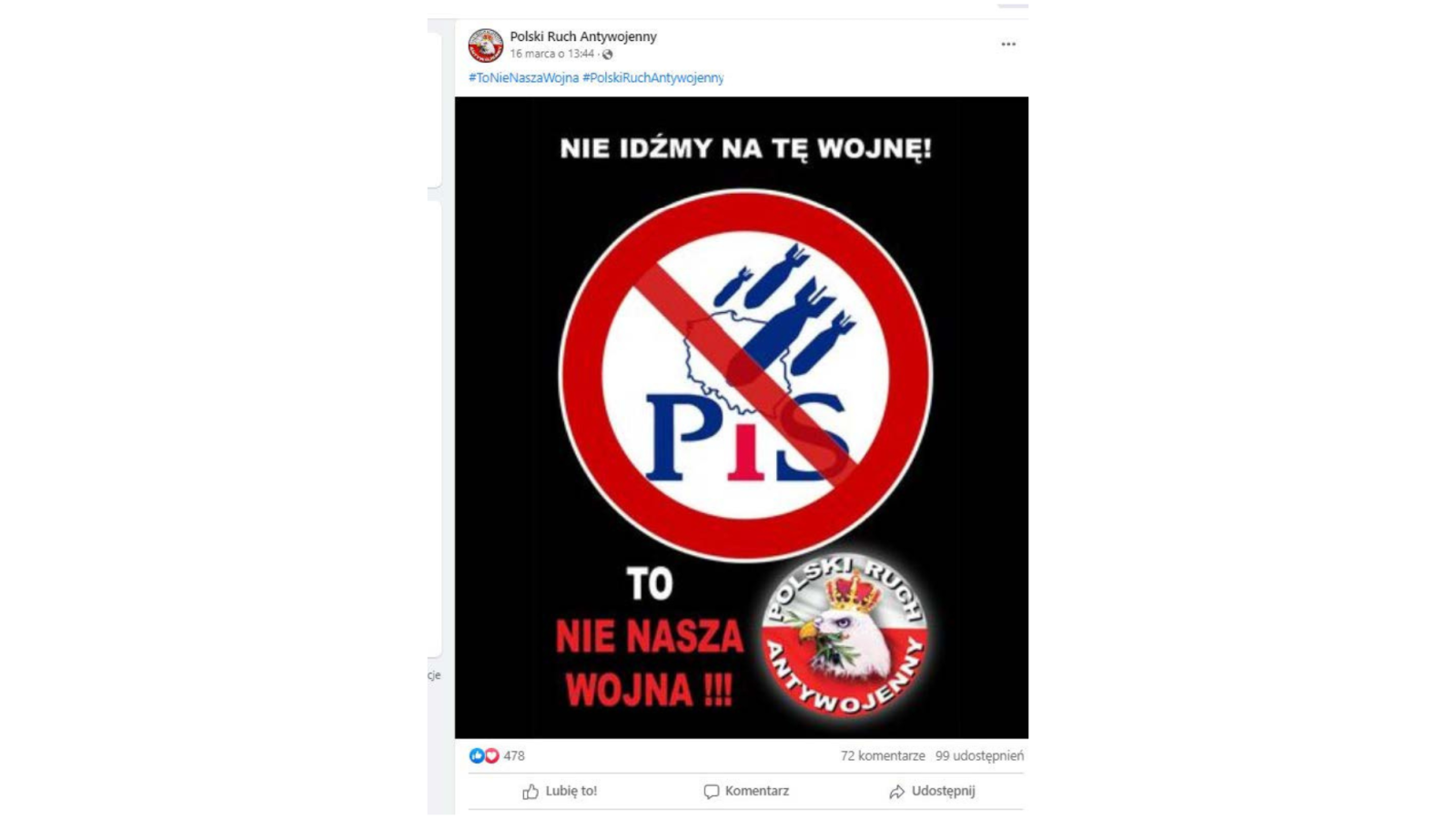
The Polish Anti-War Movement (supported by Russian state propaganda) used fear of insecurity, with social media posts advocating against the war. One example is shown in Figure 7: ‘Let’s not go to this war! This is not our war!’
4.7. Community, social, and political life
Negative views of Ukrainians provoked by political discourses and parties: To date, most mainstream parties in the research countries have not openly endorsed misleading or incendiary discourses about Ukrainian refugees. However, nationalist right wing political parties present a risk in relation to the rhetoric about Ukrainian refugees. Risks arise particularly around election times, as the fatigue of supporting Ukrainian refugees sets in, and from more fringe political activists or Russia-aligned stakeholders. During the 2022 presidential election period in the Czech Republic, the primary opposition candidate adopted a steadily more anti-refugee platform and was seen as taking the viewpoint that Czech Republic was providing too much support to Ukrainian refugees.608 Other parties adopted positions of ‘Czech citizens come first,’ including advocating to halt temporary protections to Ukrainians.609 In Moldova, workshop participants linked pro-Russian mobilisations to an opposition party and suggested that politicians have manipulated economic issues to build opposition to the war in Ukraine and to scapegoat Ukrainian refugees by extension.610 The public visibility of protests and some politicians’ pro- Russian rhetoric can be inflammatory and leave Ukrainians feeling unwelcome. Sizeable portions of the Slovak population harbour pro-Russian sentiments.611 In March 2023, anti-NATO rallies were held in Slovakia, with attendees calling for Slovak military neutrality.612 In Poland, such discourses remain on the fringes, with some ultranationalist and right-wing parties promoting various negative stereotypes and misinformation about refugees, including from Ukraine.613 Given the polarising nature of such discourses, this tension risks affecting community cohesion within host societies as well as potentially between host societies and Ukrainian refugees.
Lack of integration into host societies: Integration can generally be considered to refer to the degree to which Ukrainian refugees engage with their host communities as colleagues, neighbours, and friends. The countries included in this study varied in their theoretical openness to Ukrainian refugees; the majority of respondents to one survey in Slovakia expressed negative perceptions of refugees. However, on a personal level, respondents from all countries, including Slovakia, expressed willingness to engage with Ukrainians as friends and colleagues.614 However, participants in all research workshops agreed that the two communities remain poorly connected, with limited occasions to build relationships. Lack of integration is driven partially by return intentions in some contexts. A February 2023 survey by the EU Agency for Fundamental Rights found that 49 percent of Ukrainians surveyed in Romania wanted to return to Ukraine despite overall favourable responses on their experiences in Romania.615 One workshop participant commented that she had not thought initially about integration because her hope had been to return to Ukraine quickly, although this appeared increasingly unlikely.616 Workshop participants also shared that, as Ukrainian refugees have been in Romania for more than a year now, they will now be very much expected to integrate or migrate further.617 Contrasted with Ukrainians’ uncertainty of length of stay and the difficulty learning Romanian, possibilities for tensions arise.
Other challenges to integration include linguistic barriers, ongoing effects of trauma, and lack of opportunities or time to participate in broader community life, particularly for single parents. This can be a missed opportunity to build trust and connections among the communities.
Language barriers: Language barriers were identified as a potential source of tension across all countries. Particular challenges exist in Romania, as the Ukrainian and Romanian languages are very different. Fewest challenges were identified in Moldova, though some remained—particularly in the context of administrative requirements and higher-skilled jobs that require Romanian language skills, as well as in the context of integration. The lack of a common language has two consequences. First, it impacts refugees’ ability to carry out day-to-day tasks and access services. One study found that 20 percent of Ukrainian refugees in the Czech Republic could not visit a doctor due to the language barrier.618 Language was also cited as a key barrier to many areas of life and service access for Ukrainians in Romania.619 Such barriers can exacerbate tensions in contexts where the health and education systems are already stretched and not equipped to manage an inflow of people who do not speak the local language. The second major consequence of the language barrier is on integration. In Slovakia, in February 2023, 48 percent of people surveyed by UNHCR (including Ukrainian refugees and the Slovak host community) reported that communication difficulties contributed to existing tensions in community life, making this the primary barrier found in this survey preventing further integration.620 Reasons for lower engagement in language courses include lack of childcare, as well as the cost, lack of awareness and lack of availability of language courses.621 Research workshop participants also noted that it is difficult for working parents to juggle work, childcare, and mental stress or trauma, and to make time for regular language classes.622
Language barriers can reduce the opportunity to build friendships and community cohesion and can increase the risks of misunderstanding, frustration, and potential resentment between groups.
Cultural differences and lack of understanding: Cultural differences were mostly mentioned in Romania. Despite being neighbouring countries, the culture, history, and language of Romania and Ukraine are very distinct. Before the arrival of Ukrainian refugees in Romania, there was little knowledge of each other’s culture or language. One Romanian citizen who rushed to the Romania-Ukraine border to help refugees as soon as he heard about the war said: ‘I never even thought of crossing the border to Ukraine or Moldova before, because in my head these places are Russian (…) But now I see these people arriving: this is not Russia’. Lack of cultural understanding could lead to prejudice and tensions, and indeed one of the potentially most impactful misleading discourses about refugees in Romania is that ‘Russians and Ukrainians are the same’.
Lack of understanding of Ukrainian trauma and its consequences: The WHO estimates that one in five people fleeing war will have a mental health condition within 10 years, with one in 10 developing a severe condition such as PTSD or psychosis.623 The effects of trauma can be debilitating and last for years,624 and people deal with trauma very differently. According to the UNHCR, 14 percent of Ukrainian refugees surveyed in Poland had mental health issues, reporting feeling so upset, anxious, or worried that their functioning was affected.625 In the Czech Republic, one study found that 45 percent of Ukrainian refugee respondents had at least moderate depression or anxiety—four times more than the average Czech population. A workshop participant in the Czech Republic explained that she started working to support Ukrainian refugees in the country to manage trauma, but her work exacerbated her own trauma and caused additional stress.626 A workshop participant in Poland noted that their trauma was so crippling when they arrived in Poland that they could not function normally and did not want to think about participating in various activities.627 The participant noted that it took six months of therapy to overcome the crippling trauma. Another workshop participant In Romania commented that they knew Ukrainian refugees who struggled to complete normal daily tasks and were unable to engage positively in Romanian society, as they were acutely aware of the suffering back in Ukraine.628
Lack of understanding of trauma can lead to friction between local populations, which might perceive some refugees’ behaviour as ‘lazy’ or ‘ungrateful’, while in reality, the behaviour might be due to strong trauma. The traumatised individuals might also perceive insistence on finding work immediately as very challenging and participating in ‘fun’ community activities as irritating and diminishing their experience.
Differences between Ukrainians’ experiences: Two characteristics could give rise to tensions between different Ukrainian groups: (1) time of arrival to the host country (concerning those who were in the country before February 2022, such as members of the Ukrainian diaspora and migrants) and (2) refugees’ place of residence within Ukraine before February 2022. For example, in Poland and the Czech Republic, Ukrainian migrants had held low-skilled jobs for years. This was perceived as contributing to tensions due to the potential stereotyping of Ukrainians as low-skilled labourers.629 In Moldova, tensions could arise between Ukrainians, with a Ukrainian ethnic minority that consumes news produced in Russian, as the majority of Moldova’s Russian-speaking population, often from within the Russian Federation; many of these individuals have adopted more pro-Russian perspectives as a result. 630 Second, in all countries, the possibility of tensions relating to the specific origin of Ukrainians was mentioned. Workshop participants noted discourses about Ukrainians who came from the Western regions of Ukraine but were not seen as genuine refugees—they rented their flats in Western Ukraine to internally displaced people from the eastern part of the country and came to the Czech Republic or Romania to claim financial support, or were economic migrants and not refugees.631 Similarly, workshop participants in Slovakia shared a narrative that the war did not affect all parts of the country; therefore, Ukrainians could stay in the safe areas and fight for their country; and that their presence in Slovakia is more akin to being economic migrants than refugees.632 Such narratives have the potential to generate tensions between different communities and make refugees from Western Ukraine feel less welcome.
Fear of insecurity and war: In all five countries, significant segments of host populations fear insecurity and war,633, and fear of insecurity has been a topic in the media.634 The fear was particularly acute in Moldova where, in 2023, Moldovan intelligence confirmed it was monitoring potentially hostile activities within the country. President Maia Sandu has spoken internationally about the potential for the conflict to spread.635 Participants in the Slovakia workshops shared concerns about conscription, and an EC poll from October 2022 showed that 85 percent of Slovak respondents worried about the spread of the war in Ukraine to other countries.636 Political parties can use fear of conflict as a tool to generate anti-refugee discourses. The Polish Anti-War Movement (supported by Russian state propaganda) used fear of insecurity, with social media posts advocating against the war. One example is shown in Figure 7: ‘Let’s not go to this war! This is not our war!’.637 The fear of war, and resulting political discourses, generate hesitation and uncertainty among host communities, potentially leading to reduced support and resentment of Ukrainians and thus causing issues for social cohesion between refugees and host communities.
Tensions between Ukrainians and host communities about who started is responsible for, or should de-escalate the war—and how: In Slovakia and Moldova, responsibility for the conflict and de-escalation of the war was brought up as a source of tension. In Slovakia, a prominent ‘peace narrative’ suggests that Ukraine should seek to end the war and ‘unnecessary suffering’, which might include compromises on the part of Ukraine. One study has called this narrative ‘a euphemism for stopping the military support for Ukraine’; it has also been extended beyond the war to refer to support to Ukrainian refugees.638
Workshop participants reported cases of families hosting Ukrainians who claimed Ukraine was the aggressor in the war; this made some Ukrainians feel unsafe and unwelcome in their accommodation and led to tensions in families and between friends.639
As the war in Ukraine continues, this tension could pose a risk to community cohesion and potential hostility to Ukrainian refugees if they become a focus for frustrations about the continuation of war.
Local fatigue for supporting refugees: Across all countries, strong support for refugees continued during the first year of the war, but workshop participants mentioned that local populations are starting to feel fatigue associated with hosting refugees and that people did not expect the war to last so long. These opinions have been borne out in public opinion polls, research, and media sources.640 For example, the proportion of Czechs who ‘refuse to accept Ukrainian refugees’ grew from 13 percent in Spring 2022 to 27 percent in December 2022.641 Fatigue is associated with the unexpected length of the conflict, poor economic conditions (e.g., high inflation in all countries), and perceptions that Ukrainians receive better services and support than vulnerable members of the host communities (Slovakia and Moldova). This is an area of growing potential tension between communities.
Expectation of more gratitude from refugees: Across the five countries, workshop participants indicated that some segments of host country populations expected Ukrainian refugees to be more grateful for the support provided. These sentiments are underpinned by perceptions that Ukrainian refugees are generally better off than vulnerable populations, particularly in Moldova and Romania.642 Slovak perceptions of ingratitude were linked to a perception that the government is spending a significant amount of its budget, meant for host country populations, on refugees. In Poland, specific narratives were raised around Ukrainian families rejecting aid (e.g., accommodation) that Polish families would be willing to accept.643 Workshop participants also observed that such perceived lack of gratitude could arise from a misunderstanding of refugees’ needs, the trauma they have experienced, and their specific needs and/or the services available to them.644 It is possible that depicting Ukrainians as ungrateful may stoke further division and tension between Ukrainian and Slovak communities.
Single incidents that harm people (e.g., car crashes) might frame Ukrainians as a danger to the host society: Research workshop participants noted the risk that the media or populations could generalise individual incidents involving Ukrainians to portray all Ukrainians in a negative light.645 One participant cited issues of public safety (such as road safety) as potential triggers for worsening this tension—for example, if a car accident involved a Ukrainian refugee.646 Another participant highlighted the risks around Ukrainians working in jobs that involve physical danger and a workplace accident or health and safety issue that trigger conflict (particularly when there is a language barrier between employer and employee).647 Some participants in Poland expressed frustration about the media reporting the nationality of Ukrainians who commit crimes, for example: ‘A Ukrainian person stole a car.’648 Backlash against Ukrainians supposedly committing crimes has been noted on social media. For example, anonymous Internet users have disseminated rumours that the offender in one crime was Ukrainian, although the authorities had not determined whether foreigners were involved in the incident.649 It was noted that such singular incidents could have particular effects during sensitive periods such as election campaigns and be used for political gain to stoke tensions between communities.
Conceptions of Ukrainians as economic migrants (pre-February 2022) and stereotypes of Ukrainians as low-skilled: Before February 2022, significant numbers of Ukrainians worked in Poland and the Czech Republic, particularly in low-skilled manual labour sectors.650 While there is acknowledgement that low-skilled Ukrainian workers have contributed positively to GDP growth, in both Poland and the Czech Republic, stereotypes have also developed of Ukrainians as low-skilled. Ukrainians in the Warsaw research workshop noted that it felt demeaning to read advertisements looking for ‘Ukrainian cleaning ladies’ which implied that Ukrainians were only capable of performing such roles.651 One participant shared how such prejudice was displayed by a Pole who knew of her multiple qualifications, including a PhD, and told her: ‘If I ever have children, I’ll hire you to be their nanny’.652
Due to previous host community engagement with low-skilled Ukrainian workers, an assumption might arise that Ukrainians are planning to remain in the host countries.
Xenophobia and discrimination: According to some indexes, the five countries in this study have relatively high levels of xenophobia.653 Still, Ukrainians have received a warm welcome in the region, and discrimination toward refugees is mitigated by the understanding of their situation as well as the relative cultural similarity of Ukrainians and host communities. Refugees International suggests that, as the war continues, empathy fatigue may engender some level of xenophobia, and continued vocal and visible support for Ukrainians will be important to counteract this risk.654 An Overseas Development Institute (ODI) report notes that ‘since 2015, the dominant narratives around refugees [in Poland] has been one of “us” versus “them,” however the refugees from Ukraine have been included as part of the “us”.’655 Participants in the Warsaw workshop commented that discrimination appeared in subtle ways—for example, Poles resenting the accents of Ukrainians who work in the service industry, saying ‘they can’t understand them’; or complaining that all care workers in certain places are Ukrainian and that discrimination was particularly noticeable in the rental market.656 At one extreme, xenophobic acts in Poland have included physical and psychological violence, which has also been documented anecdotally. For example, the Monitoring Centre on Racist and Xenophobic Behaviour reported that two Ukrainians were beaten in Łódź ‘for xenophobic reasons. The attackers did not take money from the victims, they shouted “We hate you! Go to Ukraine!” and kicked those lying down.’657 Specific minority groups among Ukrainian refugees, such as the Roma, TCNs from minority groups, and transgender refugees are particularly at risk of discrimination.658 Participants in the Slovakia workshop noted that discriminatory political discourses could increase in the run-up to the 2023 elections; this, in turn, could increase tensions between different parts of society.659
Country-specific historic grievances
Historic grievances related to the Volhynia massacre: At least 40,000 Polish people were killed by Ukrainian nationalists during the Volhynia massacre in German-occupied Poland in 1943,660 with estimates of up to 60,000 people killed between 1943 and 1945.661 Despite the role of a variety of political actors (the Nazi government, the Soviet government) in encouraging the massacre, and efforts by individual Ukrainians to rescue Poles, historical grievances remain.662 Marches take place in Poland in remembrance of those killed in the massacre,663 as do commemorative ceremonies for each anniversary, with the president of the country in attendance.664 On the 79th anniversary of the massacre in July 2022, Poland’s president called on Ukraine to admit what he called ‘the shameful truth about how Ukrainian nationalists had massacred over 100,000 Poles during World War II.’665 He added that, ‘Those who we know were murderers were also heroes for Ukraine, at other times and with a different enemy, and often died at the hands of the Soviets, fighting with deep faith for an independent, free Ukraine’, referring to resistance against the Soviet Union by some of the same militias that were involved in the massacre. Indeed, in 2021, 78 Ukrainian lawmakers proposed to Parliament to name Stepan Bandera666 and Roman Shukhevych, who fought for Ukrainian independence in the 1930s and 1940s but who also took part in the massacre, as ‘Heroes of Ukraine’.667 This matter was also raised in the UK’s House of Lords, where Lord Glasman said:
"I absolutely support Ukraine. I went to Ukraine to show my solidarity with its people against the invasion, but they created a national holiday for Bandera’s birthday only last week. I urge the Minister to please say that in this war, we absolutely support Ukraine, but we must also resolutely oppose any rehabilitation of the murderers and perpetrators of the Holocaust."668
Workshop participants noted that the massacre features prominently in some media and TV series, particularly those watched by the older generations. One Ukrainian workshop participant shared that their son was asked about his views on the Volhynia massacre when applying for his national identity number in Poland.669
There is a general agreement that the Volhynia massacre has not directly affected support for Ukrainian refugees, but workshop participants noted that historical grievances have the potential to exacerbate tensions, particularly around annual remembrances of the massacre.670 There are fears that far right groups may exploit the 80th anniversary in July 2023.
Perception of worse treatment of Romanian communities in Ukraine than of Ukrainian communities in Romania: Approximately 150,000 people of Romanian origin (and approximately 300,000 of Moldovan origin) reside in Ukraine, primarily in border areas.671 The treatment of the Romanian minority in Ukraine is a political issue, with Romanian President Klaus Iohannis reportedly having called for improvements in Ukraine’s recognition of rights for the Romanian community.672 Issues include the provision of Romanian language education in Ukraine, with reports of education segregation and the closure of Romanian schools.673 Participants in the research workshop raised this as an issue that has gained attention since February 2022 and that risks reducing public support for Ukrainians in Romania.674
Protracted crisis in Transnistria: The situation in Transnistria is beyond the scope of this research project, and the differential services and treatment received by Ukrainians in Transnistria necessitate their own research. Nonetheless, the protracted crisis emerged as an area for concern among Moldovans and Ukrainians in the workshops in Chisinau. A recurring message among Moldovans was the perception that Ukrainian soldiers had supported Transnistria in its conflict against the Moldovan state in the 1990s. One participant suggested that questions were asked about why Moldovans should provide support to Ukrainians when the Ukrainian state was perceived to have fought against Moldovans’ interests historically.675 The protracted crisis has the potential to divide host communities within Moldova and stoke aggressive nationalistic or pro-Russian feelings.